52 Ancestors: The Ancestor Who Stays With Me
You have probably seen my other blog posts about the 52 Ancestors in 52 Weeks event that Amy Johnson Crow created, but you can learn more about it at the link. This is my latest installment.
Something I have carried with me since childhood that has seriously impacted nearly every facet of my life is mental illness. I don’t consider that a personal failure nor anything to be ashamed of, however please know that the story I’m about to relay is about mental illness, including treatments of the 1930s and 1940s, which can be hard for some to read. Truth be told, it was my mental health that led me down the path of genealogy, so for me, things like mental illness and intergenerational trauma go hand in hand with the stories I’m trying to uncover.
When I was 18, I had a mental health crisis for the first, but not the last, time (for those who might be wondering: today, I am a significantly happier, healthier person than I was then, in large part thanks to mental health treatments like therapy). It was during this experience that I first learned that my great grandmother, Eleanor Drouillard, had been institutionalized for decades in a psychiatric facility. From that moment on, I felt a kinship with Eleanor but also a desire to know more. Who was she? Why was she institutionalized? How did that impact her children, including my maternal grandmother? Some of these things I still can’t fully answer, but I have learned more about her in the years since, and in some ways, it has answered questions I had about myself as well.
Eleanor Drouillard was born in Ecorse, Michigan on 7 November 1902 to parents Peter Francis/Pierre Francois Drouillard (sometimes called Frank) and Anna LeBlanc. If these names sound familiar, it’s probably because I recently wrote other 52 Ancestors posts about Frank’s father and grandfather and about Anna’s parents. Eleanor was their third child and first daughter, although her parents would have ten children total. Frank Drouillard was a farmer, and he would eventually die in the very house where he was born, on Goddard Road in Ecorse. When he died in 1947, he left six sons, three daughters, 25 grandchildren, and one great grandchild. Anna died in 1933 at age 52 of “lymphosarcoma of the abdominal lymph glands” which she’d had for a year. They were both outlived by all but one of their children: their son Louis died at 29 of tuberculosis.
On 22 June 1923, Eleanor Drouillard, 20 years old, married Christopher Frank, 25, son of John Frank and Mary “Gallaint” (according to the marriage register, although her real surname was more likely Galnat). They were married in Ecorse, and their witnesses were Chris’s brother Edward Frank and Eleanor’s sister Iva Drouillard. The couple would settle in Dearborn, Michigan, where Christopher grew up.
Unfortunately, their marriage was marked with tragedy fairly early on. On 3 December 1923, less than six months since their wedding, the couple lost their first son Alvin Edward Frank due to prematurity. Alvin was buried in Woodmere Cemetery, which is not where Christopher and Eleanor would eventually be buried, but instead is likely in the plot of Chris’s family. It wouldn’t be until 1925 that the couple had their first surviving child, Loretta, although it’s unclear if there were other losses prior to the birth of Loretta.
Eleanor and Chris would ultimately have eight children total. Their second or third youngest daughter (depending on how you count twins!), Rose Anne Frank, born in 1931, was my grandmother. Rose died when I was a child, and I knew my whole life that she died because of an illness she could not shake: alcoholism. This is one reason why I was very interested in Eleanor’s story, because I could see the way her life impacted her children and then the way that rippled into affecting later generations.
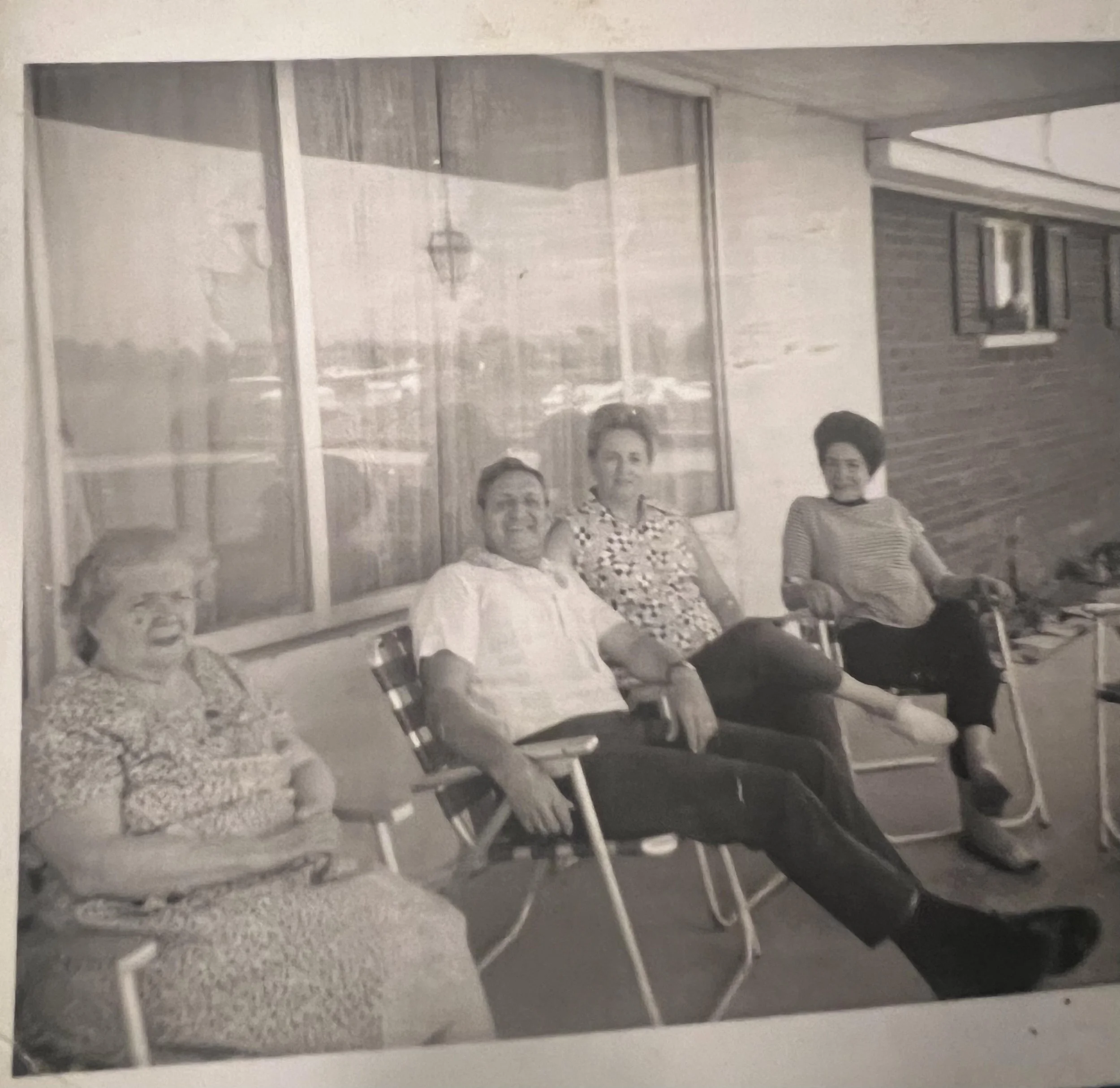
Left to right: Eleanor (Drouillard) Frank, her son John Frank and his wife Verna, and her daughter Rose (Frank) Brown, my grandmother. Photo likely taken in the 1960s.
You may be wondering what happened to Eleanor, and I still am too, to be honest. What I know is primarily pulled from family lore, although I continue to try to navigate the labyrinthine world of mental health records from nearly 100 years ago to try to find answers. This is what I have been told, cobbled together by speaking with various family members over the years:
Sometime after Eleanor had my grandmother Rose in 1931, she was institutionalized at a place that is often referred to by locals as simply “Eloise.” Eloise was first founded in 1832 as the Wayne County Poor House, although the name Eloise Hospital was adopted by the facility in 1911, likely named after the daughter of one of the men overseeing the building of the facility. Later, the name would again be changed to the Wayne County Asylum and eventually prior to its closure to the Wayne County Psychiatric Hospital. However, it wasn’t solely a psychiatric facility. It was also a regular hospital, which included buildings dedicated to patients with illnesses like leprosy and tuberculosis, but also had a farm, public school, bakery, dairy, and its own post office. The range of services provided by this facility is one reason why Eleanor is not my only relative to have been treated there — for instance, her mother-in-law Mary (Galnat) Frank had died there from tuberculosis decades earlier. The facility was closed in 1979, and many of the buildings have been demolished in the years since. One of the remaining buildings, the Kay Beard Building, is the home of a haunted house themed around “insane asylums,” which I have a difficult time with given the truly haunting history of this place for many real families. I don’t love people profiting off of that.
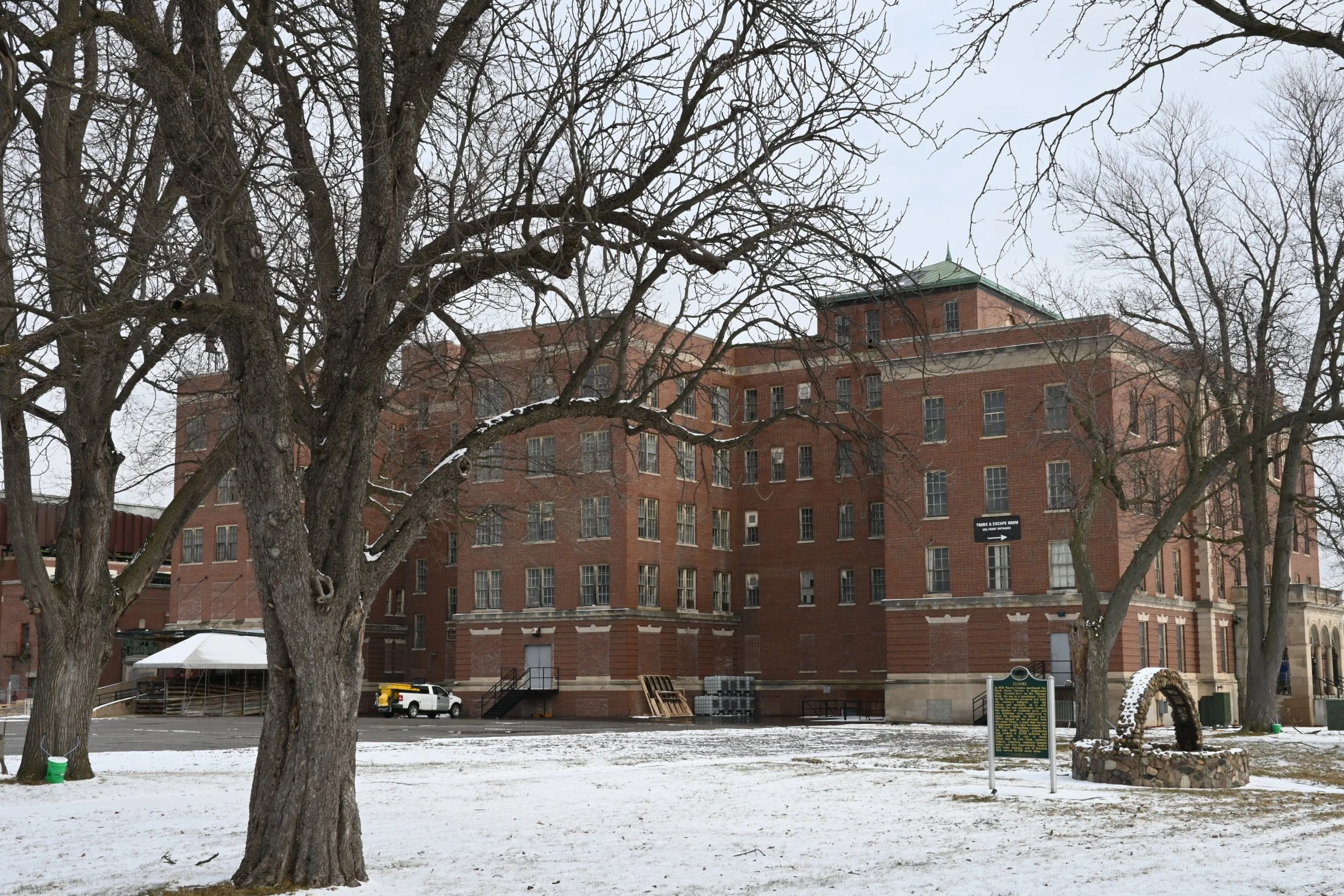
Photo of the Kay Beard Building in 2023 taken by author.
As far as why Eleanor was put into Eloise, I’m not sure. Some family members have heard she was schizophrenic and reported there were other mental health issues among Eleanor’s extended family, including suicides. One story I have consistently heard, however, is this: Chris Frank was carrying on an affair and had another family who lived nearby his family with Eleanor. I’ve been told that one story is that Eleanor found out about the cheating and threatened him with a letter opener, after which “the men in white coats came and got her.” Another story that has trickled down to me was that it’s possible something about Eleanor’s behavior put one of the children at risk, possibly even my grandmother, and so Christopher felt she couldn’t be trusted. One piece of the story that has cropped up again and again was that Chris was connected with powerful people in the area through his work, and that this enabled him to make this happen — but the truth is that in the 1930s, he likely didn’t need much power to claim his wife was crazy, whether she truly was or not.
Whatever the reason for Eleanor to be institutionalized, the result, I’ve been told consistently, was that she was given treatments like electroconvulsive therapy (ECT), which in the mid-1930s was not at all like what that treatment is today, and that it permanently changed her. I have seen home videos of her in the 1950s or so, looking vacant and being moved into place by her husband for the shot. It seems she was allowed to come home on weekends, but another consistent family story is that her doctors at Eloise were quite upset when, in early 1938, she became pregnant again.
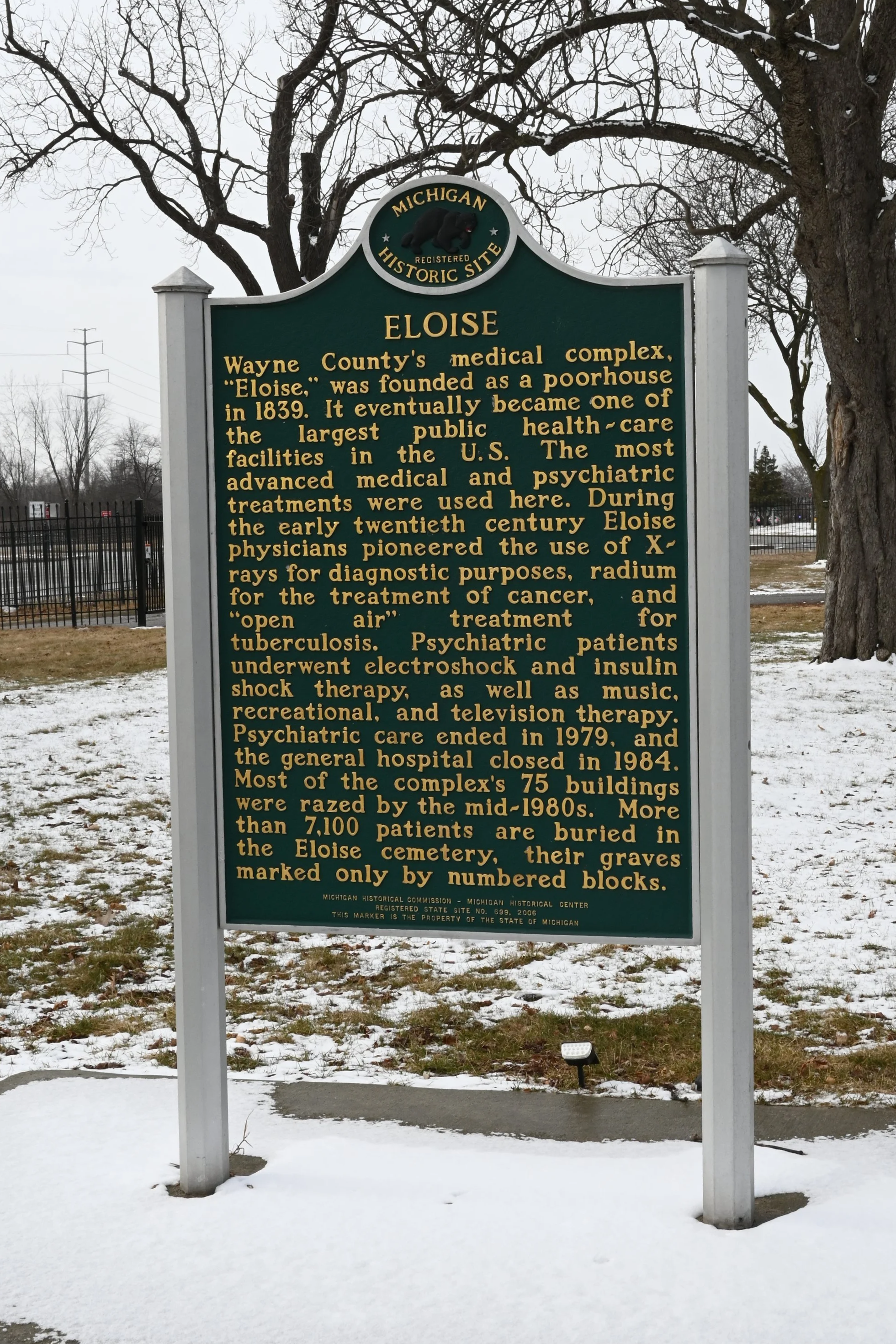
Historic marker at Eloise Asylum grounds today. Photo by author.
The pregnancy in 1938 led to twins, but it seems that didn’t really change anything about Eleanor’s living situation. I’ve been told different things about how long she was at Eloise as her primary residence, including that she was kept there until it was about to close and only then moved to a nursing home, but recently heard from a family member that she was released to her husband Christopher’s care after all their children had left home, which would have been around the late 1950s or early 1960s. Either way, she was primarily living at Eloise for most of her children’s lives.
Christopher Frank died in 1967, after which it seems that Eleanor stayed in their house in Dearborn alone with some of her children caring for her. However in the late 1970s, she was placed in a nursing home due to her physical health, and she died in 1980. One thing I find interesting is that Christopher, Eleanor, and their daughter Rose are all buried in the same plot in St. Hedwig Cemetery in Dearborn Heights, however Rose and Eleanor share a headstone, while Christopher has a separate stone. On the one hand, perhaps this was because Christopher died in 1967 while Eleanor and Rose died in 1980 and 1987 respectively. On the other hand, perhaps this was indicative of the issues between Chris and Eleanor while they were alive. Everyone involved has unfortunately passed, so perhaps I will never know.
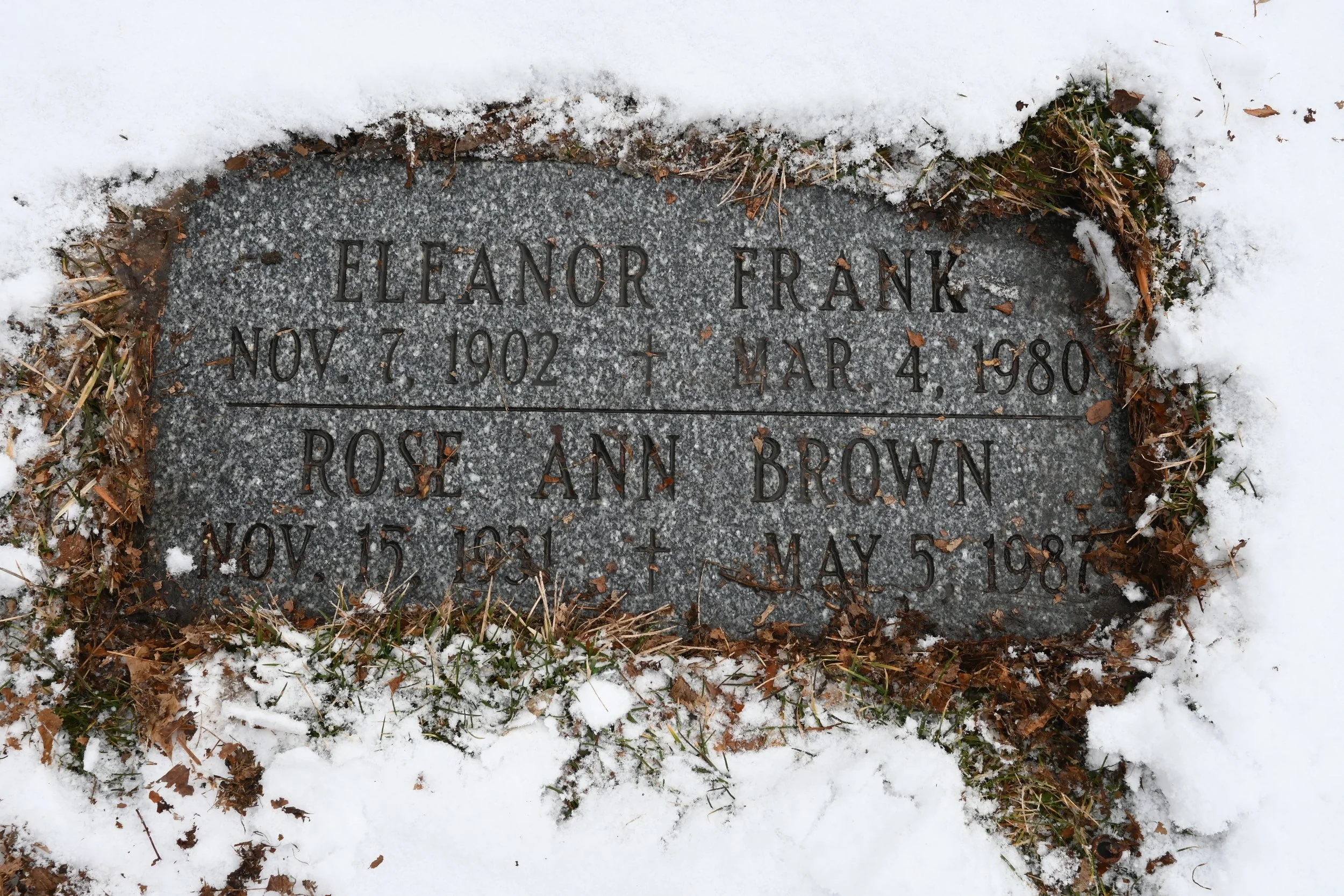
Grave of Eleanor (Drouillard) Frank and Rose (Frank) Brown. Photo by author.
When I was told about Eleanor’s time in Eloise and the impact it had on her children, I felt an immediate connection to this woman I had never met. More than anything else, it was a desire to learn about and understand Eleanor that led me to delve into genealogy. Because Eleanor does have a surviving child to this day, and they would need to be involved in requesting the records regarding her hospitalization, if the records still exist, I’ve been unable to even determine what might be out there, however it’s my understanding that many of the records regarding patients at Eloise are long gone. I’ve visited places like the Eloise Museum that’s at Westland Historic Village Park, where they have some records, but haven’t located anything connected to Eleanor.
For me, understanding intergenerational trauma is foundational to my genealogical work, because I want to not just understand who came before me but also what types of lives they lived, what they might have carried with them in terms of loss or success or challenges, and what types of legacies they left to their children and grandchildren. Because of this, in a way, Eleanor is in the back of my mind as I research, and I always return to researching her life when I am able. I will never give up on learning more about what she experienced and why, but I think it’s unmistakable that her institutionalization had a lasting impact on her children, including my grandmother Rose, and the way that has been passed down to their descendants is sometimes beautiful and sometimes difficult. But it’s a part of why I am who I am today, and so Eleanor stays with me.
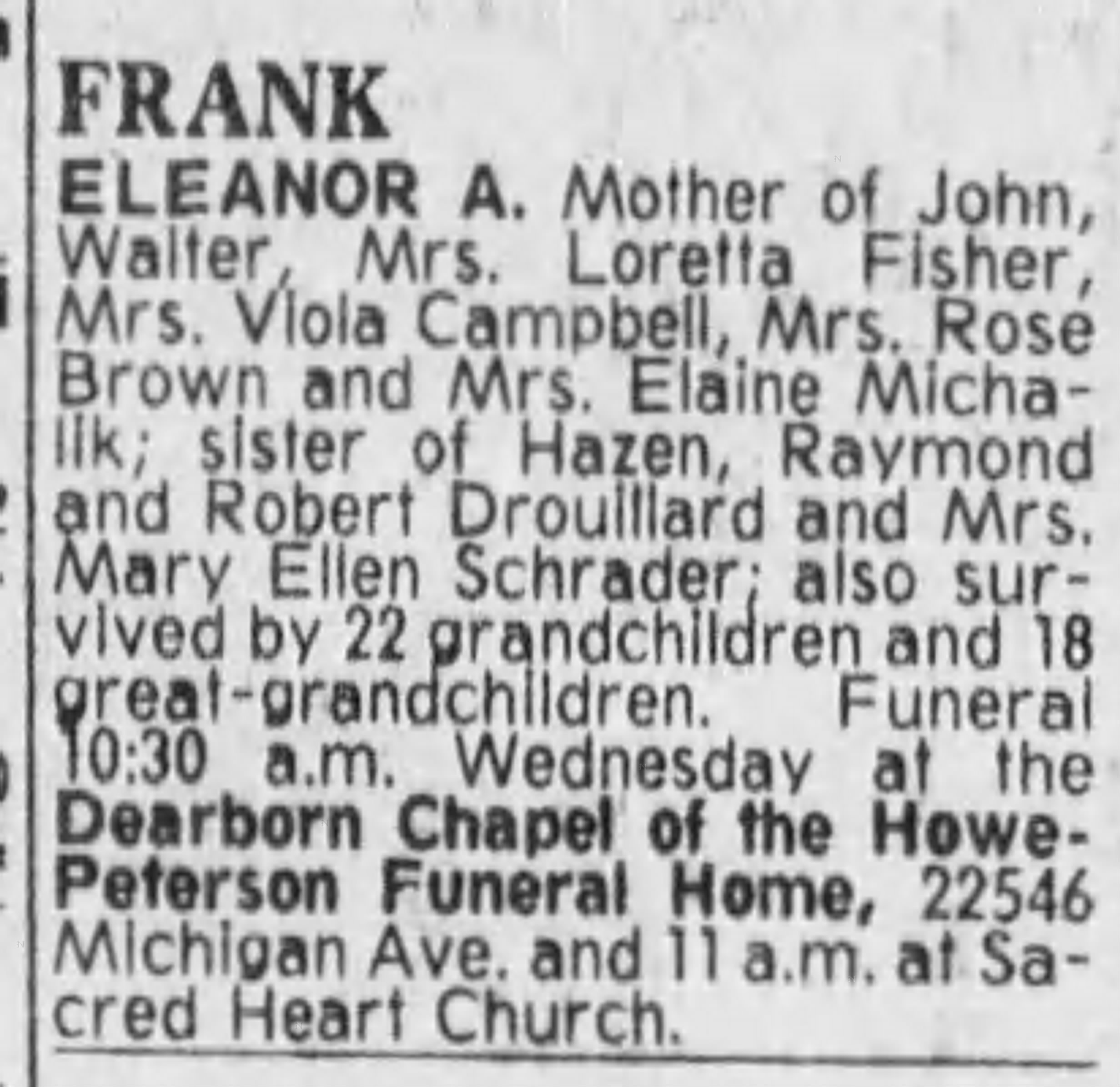
Eleanor’s obituary from the Detroit Free Press accessed on Newspapers.com.