Why I Keep Coming Back to the Wisconsin Historical Society as a Genealogist
One of my favorite parts of living in Madison, Wisconsin is that this is a city full of history. Delightfully, if you are interested in history and stop by the Wisconsin Historical Society’s Headquarters in downtown Madison, you’ll be immersed in it from the stones of the building to the library and archives it contains.
Yes, to be clear, part of why I love visiting the Wisconsin Historical Society to do some research is because it was built in 1900 and it looks like this.
Wisconsin Historical Society’s Headquarters, 816 State Street, Madison
The WHS building is on the campus of the University of Wisconsin-Madison, which causes the only downside to visiting: parking can be a mess. But that aside, it’s gorgeous and was built in 1900 to be the home of WHS—which it’s been since then! Even as they preserve our state’s history, they are part of it. Pretty cool, huh?
Wisconsin Historical Society’s Library for Genealogists
So you might be asking yourself what all of this has to do with genealogy. First, besides what is held within these walls, WHS puts on a variety of genealogy webinars that are pretty great. They also have staff that is knowledgeable if you have genealogy questions. But more than anything, it’s the WHS library and archives that hold gold for family history research.
Archives vs. Library
You should know before you visit that the Archives are in one part of the building (4th floor) and require a little more planning ahead of time, while the Library and Reading Room (2nd floor) are more accessible down to the stacks. Both have a lot to offer genealogists, and if you’re coming from further away, I’d recommend planning your visit by reviewing their collections online and reserving any materials that require it.
Archive
The WHS Archive holds a lot of original records and materials not just from Wisconsin but also from the Great Lakes and Upper Midwest areas of the United States. They hold a variety of items given to them for holding by places like Superior Courts or county governments. Although the Madison location has a lot of the materials tied to Dane County (where we’re located), even if WHS has records that are held further away, you can still request them to be brought to the Madison location to be reviewed. While visiting, I’ve reviewed everything from probate files to Sanborn maps to naturalization paperwork. It’s an incredible treasure trove that I feel like I’ve only barely touched the surface of! (Someday I’ll tell the story of finding business records for a family business in the archives and how fascinating it was)
Library
Most often, if I’m doing genealogical research, I’m visiting the WHS Library and Reading Room. And sure, part of it is because I get to research in a place that looks like this.
Wisconsin Historical Society Library’s Reading Room
During the academic year, it is often fairly full of students who are hard at work, so be forewarned. But generally it’s easy enough to find a spot to sit for your research, whether that’s at one of these tables, an armchair, a computer, or a microfilm reader.
The Library is really incredible, including six floors of genealogy materials in the stacks. I’ve been told it’s the 5th largest collection of genealogy publications in the United States! This includes many genealogy journals, books, etc. that maybe were printed in very limited quantities. They also are a FamilySearch affiliate so you can access certain records via their computers that you can’t from home, and similarly have multiple research databases from Ancestry to general history databases that can be useful.
Besides the publications and the computers, the microfilm collection is where I spend a ton of time. WHS has a robust collection of Midwestern newspapers and city directories on microfilm. Pro genealogist tip: city directories are an incredible resource for locating your family, especially in non-census years!
One of the things I enjoy about visiting WHS as an introvert is that the stacks and microfilm is all self-serve. You can wander the aisles of microfilm drawers or bookshelves to find what you want and don’t have to interact with other humans. If you do need to talk to humans, the ones that work there are generally quite helpful, especially the dedicated genealogy staff. Their pamphlet collection does require going through the circulation desk, given the more fragile nature of pamphlets vs. books. Even that is easy, although I do prefer wandering the stacks. Sometimes I’m a little concerned they’re haunted, but can you blame me?
Wisconsin Historical Society Library’s Stacks
What will you find at the Wisconsin Historical Society Library?
I’ve touched on it a little above, but to clarify the types of things you can find at the WHS Library, they include:
Microfilm records of births, marriages, and deaths in Wisconsin
Large microfilm collection of Midwest newspapers and city directories
Family history publications including written genealogies, pamphlets and genealogy journals
Various genealogy publications from all over the United States and some from Canada, all organized by location
Local and county histories from Wisconsin especially but also many other locations in North America—many of which are out of print
General history publications, which often can be checked out if you get a library card
Maps of Wisconsin, the Midwest, and North America, like the beautiful Madison one below.
Map of Madison in an atlas at the Wisconsin Historical Society Library Reading Room
What can you find at the Wisconsin Historical Society Archives?
So what about the Archives? Among their massive collection, genealogists can find:
Personal papers from Wisconsin residents, such as musicians, judges, lawyers, historians, activists, and more
Company records for Midwestern companies, especially Wisconsin
Probate records for counties across Wisconsin
Miscellaneous court records from across Wisconsin
Immigration and naturalization papers from Wisconsin Circuit Court
Historic maps like Sanborn Fire maps
Audio and video records like old news reels
Hint: you can search the finding aids for the WHS Archives here, but remember to pay attention to where the items are located and request them ahead of time if needed.
Don’t forget all of the Wisconsin Historical Society’s other resources
While the Headquarters is near and dear to my heart and where I do the bulk of my in-person research here in Madison, it’s not the only WHS location I like to visit. They actually have locations all across Wisconsin from smaller archives and libraries at other campuses to historic sites. To end on another historic building(s) I love, WHS runs Old World Wisconsin, a beautiful site in rural Wisconsin where you can experience different types of farms from our history, visit a small town, and see real historic buildings that were brought to the site to preserve our history. I love to visit OWW, so very much that my spouse jokes that one day I might refuse to leave.
An interpreter makes bread at Old World Wisconsin during their holiday event
Clearly I’m a big fan of the Wisconsin Historical Society. It’s nice as a genealogist to be able to visit places that really make history come alive for me, whether that’s through original records I get to hold in my hands, unique books I can’t find anywhere else, or pretending I’m in the eras of my ancestors.
Did I mention if you need someone to look up anything at WHS, I can do that for you? Go ahead, enable me.
52 Ancestors: A Record that Adds Color
Gerber, E. B, C. A. O McClellan, Worley & Bracher, and F Bourquin. Map of De Kalb Co., Indiana. [Philadelphia: E.B. Gerber & C.A.O. McClellan, Phila.: Printed by F. Bourquin & Co, 1863] Map. https://www.loc.gov/item/2013593194/.
Thinking about the 52 Ancestors in 52 Weeks topic for this week, "A Record That Adds Color," I decided to go a little literal.
This map of DeKalb County, Indiana was created in 1863 (digital is from the Library of Congress), and showcases detailed land ownership in the county at the time. DeKalb County is one of three counties in this area that a branch of my maternal line spent generations living in. As I traced these lines backwards, I found an 1880 map that showed where my 3x great grandfather Andrew Ferrier had land, which was in the top right corner of Fairfield Township, shown here as the pink square in the upper left.
In this map, however, that family wasn't present. But in the detail view of Waterloo City (far right is the detail, but the town itself is at the top of the yellow square in the middle), there is my 3x great grandfather Joseph C. Mead. Mead's son William would marry Ferrier's daughter Ida, eventually leading to yours truly. Being able to compare the 1880 map and this 1863 map and see the relatively close proximity of these two families added a lot of color to my understanding of their lives. Also, William Mead would spend his entire life working for the railroad in this area, so understanding the evolution of the county and railroads in it added rich context to the movements of he and Ida and their children.
52 Ancestors: An Ancestor I Admire
Janelle and Aunt Marie, 1985
I’m participating in Amy Johnson Crow’s 52 Ancestors in 52 Weeks this year, as I thought it sounded like an opportunity to look at my genealogy in new ways. I encourage you to do so as well! It’s only as much effort as you want it to be.
I was connected to my Aunt Marie before I even knew it. Marie O’Rourke was my great aunt, the sister of my paternal grandmother, and I grew up seeing her as often as I saw my grandparents. It was her first name that connected us, as my parents gave it to me as a middle name, in part to honor her as well as another family member. But along the way, I found much more that connects us.
Marie O’Rourke was born in Lake Linden, Michigan on 3 January 1926 to Thomas O’Rourke and Mary Dubuque and spent her early decades living in an apartment above her father’s bar. Marie was the youngest child by far, a real “oopsy baby” born 11 years after her next youngest sibling. This also always connected me to Aunt Marie in my childhood, as I am 11 years younger than my oldest sibling and 11 years older than my youngest sibling (my older sister is the only one who doesn’t follow the 11 pattern). Marie’s older siblings were Morton (born 1909), Gordon (born 1911), Eileen (born 1912 and my grandmother), and Gloria (born 1915). Her mother was 43 when she was born and her father was 58, and Marie would spend the rest of their lives with them.
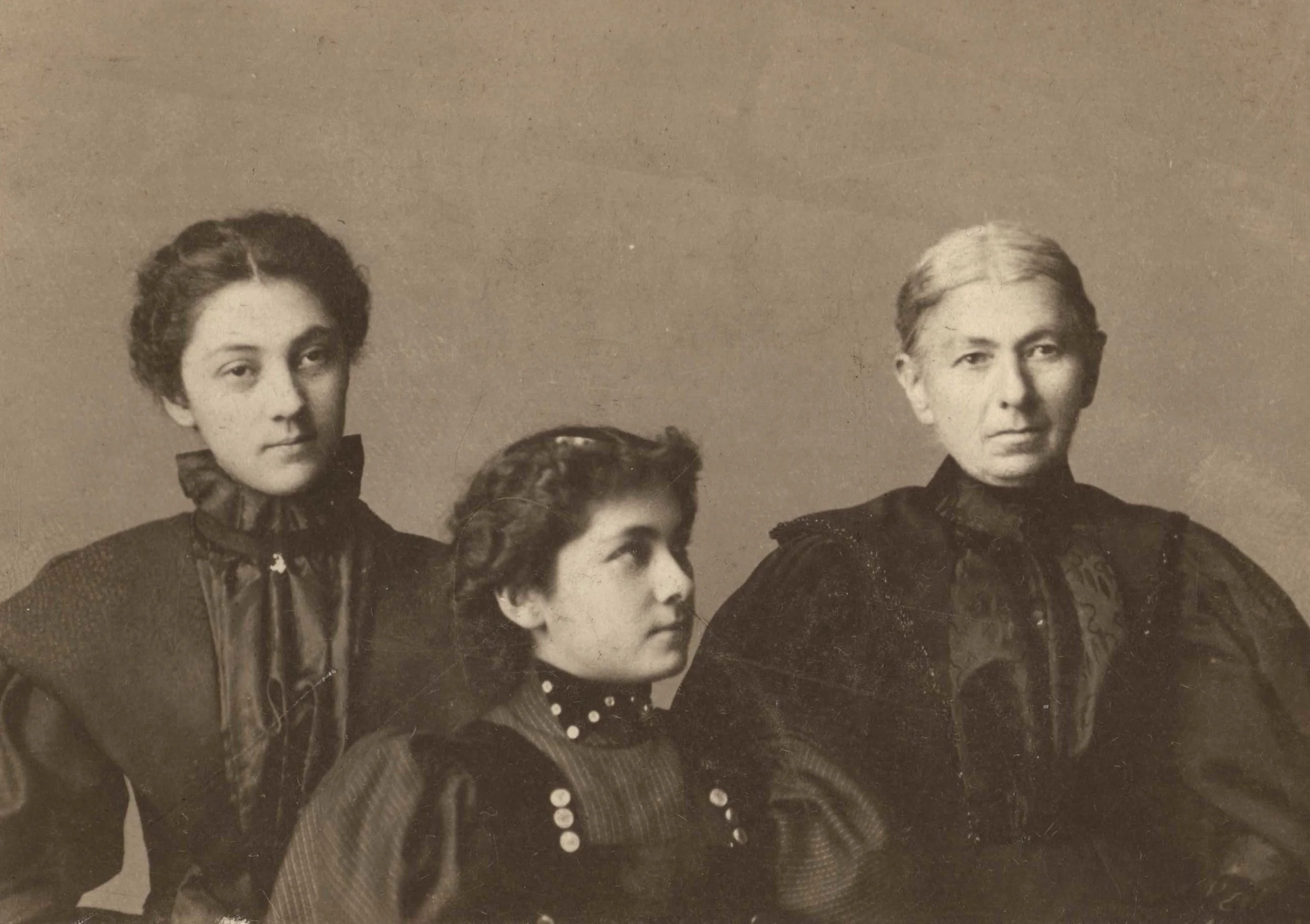
Thomas O’Rourke, Marie O’Rourke, Eileen O’Rourke — I’ve always enjoyed this photo, which makes it clear just how wide the gap in ages was between my grandmother (far right) and her youngest sister (center). My grandma was likely around 17 in this photo, while Marie was probably 3 or so. Their father (far left) would’ve been in his early 60s.
The O’Rourke household in the 1930 U.S. Federal Census was full of Thomas and Mary’s children, from 21 year old Morton to “4 3/12” Marie. Thomas worked as the proprietor of a “Soft Drink Parlor” and had been born in “Canada French” to parents both born in Northern Ireland. Research eventually uncovered that none of that was accurate, although it’s the soft drink parlor fiction that has amused the family the most over the years.
My grandmother and her siblings insisted to the end that their father had absolutely NOT operated illegally during the Prohibition years, despite being an Irish-American who owned a bar on the banks of a lake that led to Lake Superior and Canada and who had two brothers working at the Walker liquor business in Canada. They always said he had only run it as a soft drink parlor during prohibition, as they wouldn’t want to admit their father had broken the law.
Marie’s mother Mary Dubuque is described more accurately as the Michigan-born daughter of a “Canada French” born father and a Michigan-born mother. In 1930, even 21 year old Mort was still in school, likely college, as were all of the other children besides Marie who was too young. But by the 1940 U.S. Census, all of the older siblings had gone off to live their lives, and the household was just Thomas and Mary and youngest daughter Marie.
In 1940, Marie was 14 and in school. Thomas was described as a “Bartender” at a “Tavern”—at first it seemed like he sold his bar at some point between 1930 and this census since he was nearly 70. But other documentation shows this was simply an error on the part of the enumerator.
Thomas O’Rourke at work
However, in the 1950 U.S. Census, once again Thomas, Mary, and Marie are living together, and Thomas is still working, once again listed as the proprietor of a tavern that he owned, now at age 79. According to Thomas’s son Gordon in a 10 page document he wrote about the family history, “Gordon O’Rourke operated a tavern in Hubbell with his father for twenty years… The O’Rourke’s Bar was sold to Emilio Bonanni and son Alfred on October 20, 1951.” There are likely some clues as to why Thomas felt willing to sell his bar in 1951 within the 1950 census. Marie was then 24 and done with school, and she was working 40 hours a week as the secretary for a railroad office. It was no longer Thomas’s sole responsibility to support the three of them.
According to Gordon’s document, “Marie O’Rourke was born at the Lake Superior Hospital in Lake Linden on January 3, 1926. Her god parents were her 14 year old brother Gordon and cousin Mabel Piche. Mabel was nurse and housekeeper during mother O’Rourke’s confinement. After the sale of O’Rourke’s Bar and apartment, Marie with her mother and father purchased a home in Lake Linden to live. Tom O’Rourke died on December 14, 1957 at age 89. In 1966, Marie and her mother moved to Houghton where Marie had been secretary at Gundlach Construction Co. since 1962. Prior to that, she had been employed by Copper Range Railroad of Houghton for 17 years in the same capacity.”
Morton, Gloria, Mary, Thomas, Eileen, Gordon, and Marie O’Rourke at a celebration of Mary and Thomas’s 50th anniversary.
Marie never married, and she lived with her parents until they both had passed away. She was happy to work full time but be there for her parents as they aged, as her siblings went off to other parts of Michigan near and far and got married and had families. But the entire family was always quite close. Gordon wrote about the loss of their parents:
“In March of 1941, Dad and I drove to Mayo Clinic at Rochester, Minnesota where he underwent throat surgery. It left him with a softer voice but also permitted him to enjoy another sixteen years of life. In September of 1957, we again returned to Mayo. This different surgery overtaxed the capacity of a man nearing his 89th year. He often remarked that he considered himself ‘blessed’ to be cared and comforted by Mary, his partner of fifty years, and his loving daughter Marie. On the snowing Saturday afternoon of December 14, 1957 sitting in his favorite chair, talking with our Mother, Dad suddenly stood erect, sat back down, and closed his eyes forever. After the death of her husband, Mary Dubuque O’Rourke lived on in Houghton with her daughter Marie until she was called to her ever lasting home on January 10, 1975, only two months from her 92nd birthday.”
When I knew her, Marie had retired from her full-time employment and no longer supported either of her parents. Marie lived in an apartment in Houghton, Michigan, and worked part time at the jewelry counter at a local department store. When we would visit, we’d often pop into her store to say hello, and she’d be delighted. Aunt Marie always had a full face of makeup and was dressed to the nines, and it made perfect sense to me even at a young age that she would be working at a jewelry counter.
As my other great aunts and uncles were focused on their own children and grandchildren, and as my own grandparents had seven children and over twenty grandchildren, I was delighted to get Aunt Marie’s attention on our visits “up north.” Especially as I was on the younger end of the grandchildren, so my cousins started adding great grandchildren to the mix when I was only six. There was one particularly memorable experience when I was about four years old. My grandpa had a heart attack and was in the hospital, and so my parents packed up us kids and we went up to stay with my grandma for Christmas. That way we could be close and visit my grandpa and my grandma wasn’t alone. My Aunt Marie joined us for the Christmas festivities, and all of that added up to a special Christmas that was quite different from our other Christmases.
Marie died in late 2011 and was followed just six months later by her sole surviving sibling, my grandma Eileen. Marie’s obituary describes a busy life:
“Marie O'Rourke, 85, of Houghton, passed away on October 29, 2011 at Cypress Manor in Hancock.
She was born January 3, 1926, in Lake Linden, a daughter of Thomas and Mary (Dubuque) O'Rourke. She graduated from Lake Linden-Hubbell High School in 1943. She worked for the Copper Range Railroad until 1972. She was then employed by Herman Gundlach Const. After her retirement, she worked part time at Gartner's in Hancock. She also volunteered with the Portage Hospital Auxiliary in Hancock.
She was a member of St. Ignatius Catholic Church in Houghton and the Altar Society, and she was a member of the local Business and Professional Women's Association.
She was also preceded in death by her parents, brothers- Morton (Grace) O'Rourke and Gordon (Edna) O'Rourke, sister- Gloria (Robert) Smith, and brother-in-law- Leonard Asselin.
She is survived by: a sister- Eileen Asselin of The Bluffs in Houghton and many nephews and nieces.”
Grave of Marie O’Rourke
Since Marie passed in 2011, I’ve had time to think about who she was and what she meant to me. That last decade of her life, I was busier with my own 20-something things and I didn’t visit as much as I should have, but I felt the loss of Aunt Marie as much as I felt the loss of my paternal grandparents. I still distinctly remember the day I found out she died and the ache in my heart.
Now, as a childfree, middle-aged woman, I see more deeply how easy it can be for everyone to dismiss our contributions to the world and to our families. It’s one of the greatest joys of my life, however, to be an aunt, and I know that Aunt Marie was the same. I don’t know why she never got married or had children, although I’ve heard speculation from various family members (she was the right age to lose a sweetheart in World War II, for instance). But I so admire that Aunt Marie showed up for her family over and over again for decades, while also walking her own path.
A few years ago, a cousin sent some family videos from our 1985 and 1990 family reunions in Michigan. I took a screen capture of Marie and me, so taken with her clear care for toddler me. This was just one frozen moment of her holding me and walking around with me, talking about everything. I was very lucky to have my Aunt Marie, and I hope I can be half the auntie she was.
Just two Maries, enjoying Michigan summer in 1985
When to Hire a Professional Genealogist
Many people begin genealogy on their own—and that’s a wonderful way to start (that’s what I did!). But it’s also common to reach a point where progress slows or questions become more complex. Also, not everyone enjoys getting deep into the research but you might still want to know more.
Signs You Might Need Help
You may benefit from professional guidance if:
Records are difficult to locate
Information conflicts across sources
You’re unsure if your conclusions are accurate
You want help understanding historical context
What a Professional Genealogist Does
A genealogist can:
Navigate complex or obscure records
Interpret documents accurately
Break through research roadblocks
Provide clear documentation and citations
Research With Confidence
Professional support doesn’t replace your curiosity—it strengthens it. Whether you’re confirming family stories or exploring new questions, guidance can make the process clearer and more meaningful. Because I know there are folks who might just want a little help but still want to do the research themselves, I do offer research consulting meant to help you take your research further.
If you’re ready to explore my genealogy research services, working with a professional can help you move forward with confidence.
Using Census Records for Beginners: What They Reveal About Your Family
Census records are often the first major breakthrough for people starting their family history—and for good reason. They offer a snapshot of everyday life, placing your ancestors in a specific place at a specific moment in time.
What Census Records Can Tell You
Depending on the year, census records may reveal:
Names and ages of household members
Birthplaces
Occupations
Home ownership
Immigration status
Together, these details help build a timeline of your family’s movements and experiences.
How to Read a Census Record Carefully
Census records aren’t always perfectly accurate. Information was often provided verbally and recorded quickly.
When reviewing a census:
Expect spelling variations
Compare ages across multiple years
Look for consistent locations or neighbors
Patterns matter more than perfection. You can learn a great deal from the information that is repeated decade after decade about a family.
Following Families Over Time
One census rarely tells the full story. By comparing records across decades, you can:
Track migration
Identify children who left home
Spot remarriages or extended family members
This is where census research becomes especially rewarding.
Common Beginner Mistakes
We all make mistakes when we’re starting out, but if you don’t want to make some of the most common beginner mistakes, avoid:
Assuming spellings are fixed
Overlooking nearby households
Ignoring column headings
If there’s any advice I would give a new genealogist, it’s that taking time to read the entire page often reveals important clues. You can also find the original enumerator instructions online, if you really want to understand why certain things were recorded in a specific way.
When You Hit a Roadblock
If census records stop lining up—or you’re unsure whether you’ve found the right family—guidance from a professional genealogist can help ensure accuracy and prevent incorrect assumptions.
Census records don’t just document who your ancestors were—they show how they lived.
What Records You Need to Start Your Genealogy (And Which Ones Can Wait)
One of the most common questions I hear is: What records do I actually need to begin working on my genealogy? The answer is simpler than many expect. You don’t need every record—just the right ones at the right time.
If you’re starting your family history, this guide will help you focus your efforts and avoid overwhelm.
The Core Records to Begin With
Start with records that establish identity, relationships, and locations.
1. Vital Records
These include:
Birth certificates
Marriage records
Death certificates
They provide foundational information like names, dates, parent names, and places. Keep in mind that depending on when you are researching, these records may be missing, damaged, or never existed. For example, since in many parts of the United States birth registrations didn’t become required by law until the beginning of the 20th century. There may be alternate records you can use, such as religious baptismal records if there’s no birth certificate available. But especially when you are researching more recent family members, vital records can be incredibly important and informative.
2. Census Records
Census records are used by governments to understand their residents, including ages, ethnicities, family makeup, and more. The United States has conducted a federal census every 10 years since 1790, although the specific information you can find on each census can vary (and, sorry to say, the 1890 census was mostly destroyed). Census records place families in a specific time and location, often revealing:
Household members
Ages and birthplaces
Occupations
They are especially helpful for tracking families over time. Be warned that since those taking the census (census enumerators) were often handwriting the information as they went door to door that spelling of names and specific details regarding birthplaces, ages, etc. can be inaccurate. It’s still a good starting point, but it’s good to be aware of the flaws in these records.
Learn more about using census records for genealogy in our beginner guide.
3. Obituaries, Funeral Records, and Cemetery Records
Obituaries are typically the most useful, and often contain:
Extended family names
Places of origin
Community connections
They’re excellent sources for confirming relationships, and thanks to the rise in digitized newspapers available online, you may be able to find obituaries from your computer with a search on Newspapers.com or NewspaperArchive.
Records You Can Wait On (For Now)
Advanced records—such as land deeds, probate files, or immigration manifests—are valuable, but usually best explored after the basics are established. This is especially true when you are a beginner at genealogy.
Starting too deep too soon can lead to confusion or incorrect conclusions. Gain familiarity with using vital records, census records, and obituaries; reading older records and the handwriting on them; and accessing records in the areas you research. This will help you gain skills you need for more complex records. Additionally, as you get deeper into your research, consider attending webinars or classes online about these more advanced records, so that you can use them effectively. (I recommend ConferenceKeeper for finding upcoming classes!)
Organizing as You Go
Create a simple system:
Minimal folders but enough to keep yourself organized—I have a “maternal” and a “paternal” folder, personally
Clear file names with (at minimum) year, surnames, and what the file is
Example from my files: Rourke Michael_1830_Land Purchase_Maidstone Ontario Ca_FS
Notes about where each record came from including a link or name of the repository—in an ideal world, this would be a full citation for the record, following what’s outlined in Evidence Explained
Good organization saves time and protects accuracy. Plus, if you hope to one day share your family history research, you will need to be able to cite each source you reference.
When Records Feel Confusing
Old handwriting, unfamiliar terminology, and conflicting information are common challenges. This is often where working with a professional genealogist becomes especially helpful.
A strong foundation makes every future discovery more reliable and meaningful.
Creating One Research Question to Guide Your Family History
When people feel overwhelmed by genealogy, it’s often because they’re trying to answer too many questions at once. I have definitely been guilty of this, especially when I was first getting started with genealogy. I refer to this sometimes as going galaxy brained, when I’m trying to think of too many different things at once. It’s not an effective research strategy!
Genealogy works best with one focused research question—just one part of my starter guide to genealogy.
What Is a Research Question?
A genealogy research question is a clear, specific question you want to answer, such as:
Who were the parents of my maternal grandmother?
Where was my great-grandfather born?
When did my grandmother immigrate?
These questions give your research purpose and direction. Although sometimes we never find direct, infallible proof to answer our questions, we should at least be able to find enough to form a hypothesis in response to them. This allows us to feel we have researched the question from every angle, have our best guess at the answer, and now we can move on to the next question.
Why Focus Matters
Without a clear question, it’s easy to:
Browse records aimlessly
Repeat the same searches
Feel stuck or frustrated
A single question keeps your research manageable and intentional.
What Makes a Good Beginner Question
A strong research question is:
Specific
Focused on one person or event
Answerable with records
Avoid questions that are too broad, like “Where did my family come from?”—there isn’t one answer to that nor does it really direct your research. A better version of that question would be “where was my great grandmother [name] born?” It might not answer your entire broad question, but it’s one piece of the puzzle.
One Question at a Time
Once you’ve answered—or reasonably hypothesized an answer—one question, you can move on to the next.
This step-by-step approach is how genealogists build accurate family histories over time. It’s the building block of all solid, reliable genealogical research. If you are worried about doing genealogy right, this is one of the most important pieces.
If you’d like occasional guidance like this delivered to your inbox, you can join my email list.
Talking to Family Members About Their History
For many people, genealogy feels like it begins with records. In reality, it often begins with a conversation. I know when I was getting started, the first person I reached out to was my mom. Even though we had often talked about family stories so I knew she would have lots of details for me, I was surprised to learn she also had some documents about family history on both her side and my dad’s side. The information she provided was a big help when I was getting started.
Family members—especially older relatives—carry stories that never appear in official documents. These stories provide context, personality, and direction for your research, helping you understand not just who your ancestors were, but how they lived.
Why Family Conversations Matter
Family stories can reveal:
Nicknames or name changes
Migration stories
Family traditions and beliefs
Relationships that don’t show up in records
Family members who ended up with photos or documents
Even small details can become valuable clues later.
How to Start the Conversation
You don’t need to approach this like an interview. Some of the best conversations happen casually. Especially given that we are deep in the holiday season when many folks visit family, this is a great time to connect with relatives you don’t always speak to in depth.
Try open-ended questions like:
Where did our family come from?
What do you remember about your grandparents?
What’s your earliest memory?
Who were your aunts and uncles?
Are there any family stories that were often told when you were growing up?
Listen more than you speak, since silence often encourages deeper memories, but also remember to remain engaged with the speaker and ask thoughtful follow-up questions.
Be Mindful and Respectful
Not all family history is easy to talk about. Be sensitive to emotional boundaries, and remember that not everyone will want to share everything. Additionally, older generations can see some things as shameful that younger people don’t see the same way. It’s important to understand that topics that might seem harmless to you could be upsetting for those you’re speaking with.
If someone prefers not to talk, that’s okay. You can shift to a different topic or speak with someone else.
Preserve What You Learn
Write things down, record audio (with permission), or take notes afterward. Capture names, places, and approximate dates, even if they feel incomplete.
When Family Stories Raise Questions
Sometimes stories conflict or feel incomplete. That’s normal. These moments often point toward records that can clarify or confirm what you’ve learned.
If you’d like help turning stories into documented research, professional genealogy research can provide clarity while preserving what matters most.
Welcome to the Heart of Prairie Roots Genealogy
Hello! My name is Janelle Asselin, and I have spent nearly my entire adult life researching my own family history while I worked as an editor. As my passion and dedication to genealogy has grown, it led me to decide to pursue genealogy more deeply. I love the written word and always will—but diving into research to help history come alive for myself or others is so fulfilling and enjoyable. Thankfully, it’s important that good genealogists are also good writers, editors, and critical thinkers… all skills I’ve been developing in my editorial career. I plan to use this space to write about my personal research, subjects and areas of genealogy I’m interested in, and genealogy tips and tricks. I love how supportive the genealogy community is, and I want to honor that with my own writing.
So how did I get here?
We have to go back to a little girl in Nebraska who was obsessed with history. I grew up in an old house on an acreage with my parents, two siblings who were quite a bit older, and later a younger sister who was quite a bit younger. I spent a lot of time with books, particularly those about history, reading quietly in a corner while (as my family now knows) also eavesdropping on whatever latest family gossip the older members of the family were talking about.
Janelle, age 10
A few of my most treasured memories from childhood are: visiting Laura Ingalls Wilder’s homesites in De Smet, South Dakota; watching family home videos over and over again; the moment my mom put a paperback of Little Women in my hands in a bookstore; running around in the land and woods behind my house in full 19th century dress; looking through my parents’ large collection of photos of our family; choosing Pleasant Company (now American Girl)’s Meet Kirsten book at a Scholastic Book Fair; and sharing my beloved doll with my grandmother only for her to produce her childhood doll from around 1920 to tell me about.
As I grew up, my love of books and history grew with me. I was very academically-inclined and did well in school. Although journalism interested me and I initially went to college with a plan to pursue a career in journalism, a combination of my love for books and the growing decline of print journalism made an English degree a better choice. Life threw me some curveballs as I was working through my college education, but I eventually graduated magna cum laude with a Bachelor of Arts degree in English Language and Literature before also obtaining a Masters of Science in Publishing.
Janelle at her Masters of Science graduation, 2011
In February 2010, I was going through a time of great change in my life. I was in my mid-20s; I was living in Brooklyn, New York, in my first solo apartment; I’d just started my graduate program; and I’d just gone through a divorce. I was less than three years into my career as an editor, which I loved, but I felt a little adrift. Suddenly, I was going home to only my two cats at the end of the work day, and it felt as if there were a lot more hours in my day.
And then Ancestry dot com reeled me in!
Like many people at this time, I was watching the American version of Who Do You Think You Are? and it led me to sign up for an account at Ancestry. The first emails I have about genealogy are from March 2010, as I shared census findings with my mom for her parents and grandparents.
In those early days of delving into my family history, I didn’t understand the basics of good genealogy research. Somehow, despite being in the midst of a degree where I did a great deal of research for my thesis, I never connected the dots between academic research and genealogical research. So instead, I did what many newbie family historians do: I clicked on the hints on Ancestry, and accepted most of them at face value. I rarely stepped outside that one website, and I accepted the suggestions of other people’s trees without verifying their information.
Now, if this is where you are in your genealogy journey now, please know that it’s okay—any mistakes made at this stage can be corrected. I’ll even be writing a bit here to help educate and inspire you on how to improve your research and correct mistakes.
In more recent years, however, I wanted to ensure my genealogical research was as solid as it could be, and I began exploring genealogy education. Did you know that the genealogy community offers endless numbers of interesting webinars, institutes, courses, and more to teach you everything from the very basics up to the most unique, niche areas of research? The best source for discovering these offerings is ConferenceKeeper.org, but there are many other places that list or provide educational options.
I opted to take the National Genealogical Society’s “Advanced Skills in Genealogy” course, which I found immensely useful. It’s a robust program, self-led but with mentor reviews of assignment. I learned a great deal, but I am happy now to have shifted gears from intensive education (while working full time!) back to the research and storytelling I so enjoy.
For me, genealogy ultimately is about people and our connections to one another. And while a large part of exploring those connections is the research and analysis necessary to gain further understanding of events in the past, another significant part is telling those stories. Whether that’s just making sure you have built your family tree and documented the events in people’s lives or putting pen to paper (or fingers to keyboard) and writing a narrative account, you are telling the stories of those who came before.
I believe that it is not just those who had great wealth, wrote history books, held positions of power, or put their name to something who deserve to be remembered and have their stories told. I know that I wish to be remembered long after I’m gone, as I’m sure most of us do. I also believe that while we all choose who we would like to be in this world, that a great deal of what we start with comes from those who came before. I deeply enjoy building the story of a family, the individuals, the events, the connections to others and to historical happenings, and putting it all together for the people of today. That has long been true for my research into my own family, but is also true of research I do for others.