Beyond the Motor City: French-Canadian Roots in Early Detroit

Skyline of Detroit, Michigan, 2019.
I like to joke that I’m the most Michigander person who has never actually lived in Michigan. My roots in Michigan go deep and wide, from the Upper Peninsula to Detroit, from Canadian immigrants in the 1880s to Canadian immigrants in the 1700s, and a whole mix of German, Scottish, English, and New Englander families in between.
One of the things that is perhaps less known about Michigan is that before the assembly lines and the bustle of the modern Motor City, there was a quiet river settlement defined by "ribbon farms" and French-Canadian grit along with Native cooperation and business. To truly understand Detroit’s heritage, we have to look back to 1701 and the founding of Fort Pontchartrain du Détroit.
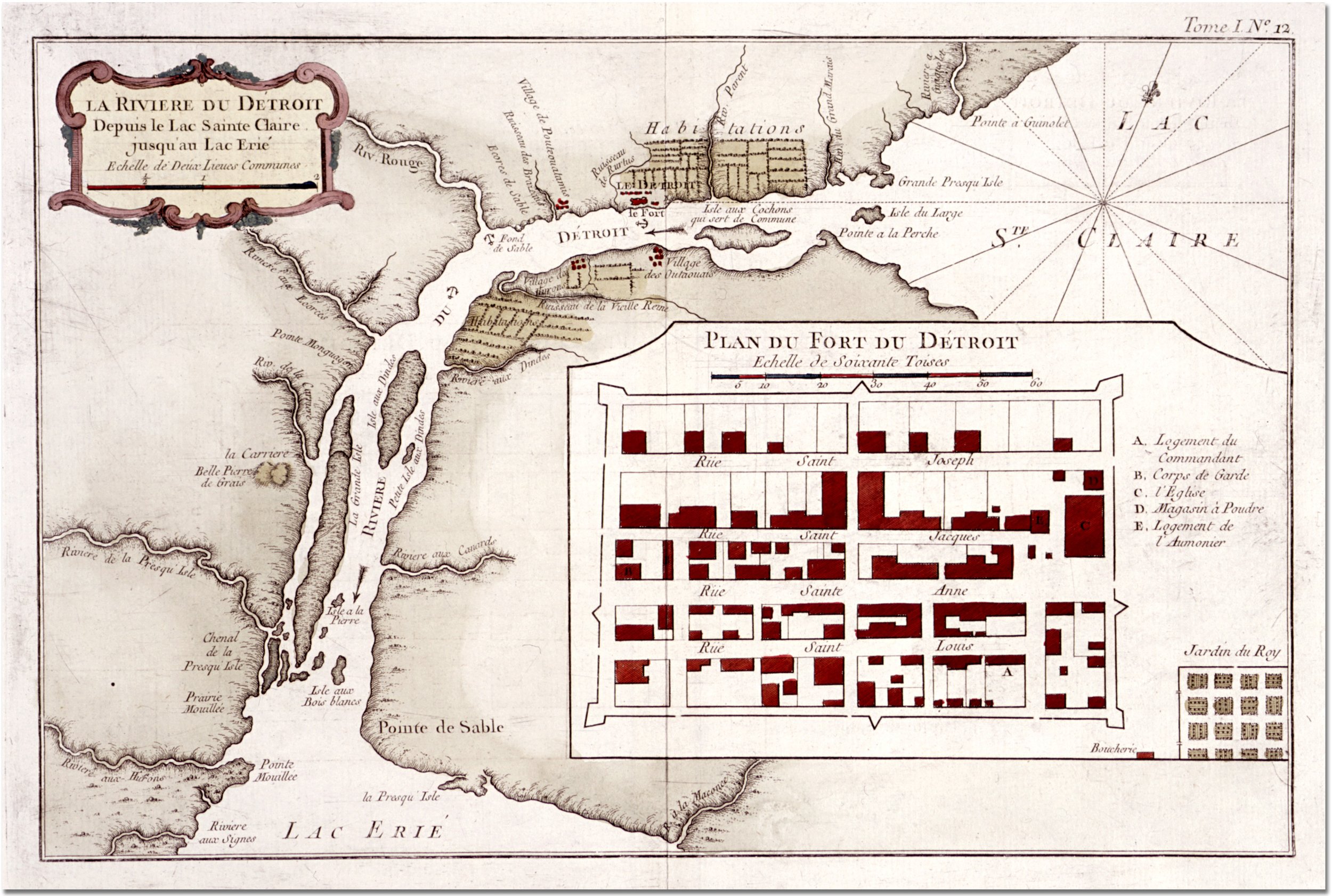
A 1700s map of Fort du Detroit. Source
Fort du Detroit of New France
Many Michigan families can trace their lineage back to these early French settlers who traveled from Quebec, Ontario, and elsewhere in what is now Canada. These ancestors left a unique paper trail that feels a bit different from later English-speaking migrations and fell under varying jurisdictions depending on the year.
How to trace your French-Canadian ancestors in early Detroit:
Catholic Parish Registers: These are the gold mine of early Detroit research. Records from St. Anne’s offer incredible detail on births, marriages, and burials, but even as Detroit expanded, Catholic records remain key for tracking ancestors over generations.
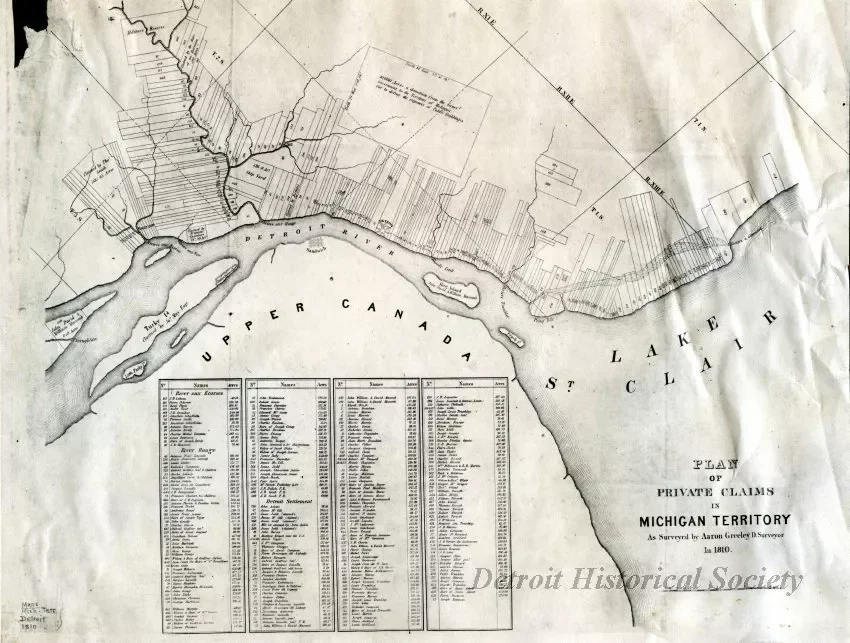
The "Ribbon Farm" Maps: Ribbon farms were long, narrow strips of land along the Detroit River. These farms are a hallmark of French settlement patterns. See the example below, but note that for instance I located a map with my French-Canadian ancestors noted on their ribbon farm with a smaller local historical society, although that same map isn’t available online. So if you aren’t able to locate your ancestors on digitized maps online, don’t assume there aren’t any records of where their property was.
Government Records: Depending on what timeframe you’re researching, court records, government records, and even censuses may fall under Canadian, United States, Michigan, or territorial purview. Keep reading for the timeline of Detroit, which can help you sort out where to look.
Timeline of Detroit
Pre-1701~Indigenous Nations: The area, known as Waawiiyaatanong, was home to the Anishinaabe (Ojibwe, Odawa, and Potawatomi), Wyandot, and others. Records are primarily oral traditions and later treaty documents.
1701–1760~New France: Founded as Fort Pontchartrain du Détroit by Cadillac. Records: Catholic Parish Registers (St. Anne’s), New France government records, and French colonial land grants where records were created.
1760–1796~British Empire: Captured during the French and Indian War. Despite the 1783 Treaty of Paris, the British held the fort until 1796. Records: British military records and early land board minutes.
1796–1805~United States (Northwest Territory): The U.S. took formal control. Detroit became the seat of a massive Wayne County that included parts of modern Ohio, Indiana, and Illinois.
1805–1837~Michigan Territory: Established with Detroit as the capital. Boundary disputes with Ohio (the "Toledo War") occurred during this window, affecting southern Michigan records.
1837–Present~State of Michigan: Michigan admitted as the 26th state. Wayne County boundaries were gradually reduced to their modern dimensions by 1826.
The many changes in and around Detroit from its early days as a fort can make it challenging to know where to look for records. Uncovering these colonial roots is more than just finding names; it’s about understanding a story of resilience and change that helped build the Great Lakes region into what it is today.