
Remembering a young soldier
Throughout my family tree, like many other folks around the world, there are members of the military. This includes everything from a likely connection to an American Revolutionary War soldier to my Irish 3x great grandfather serving in the Canadian militia to my brother’s 20+ year military service. When I think of Memorial Day, however, I think of my great uncle Emile Joseph Asselin, who is buried in St. Mihiel Cemetery in France.
Emile was the son of my great-grandfather Joseph Asselin and his second wife, Cordelia Bonin, while I’m descended from Joseph and his third wife, Claudia Caron. I’ve written about Claudia before, but she plays a surprising role in the story of Emile’s military service, as you’ll see. Emile was born in 1895 probably in Norway, Michigan, where his father had moved after immigrating from Quebec in 1882. Joseph had previously been married to a woman named Adelina, and with her he had his first three children: Maxime (1882), Anna (1883), and Mary Louise (1885). Adelina died sometime between Mary’s birth and Joseph’s remarriage to Cordelia around 1889 or 1890. Joseph and Cordelia had three children as well: Donat (1890), Albert (1892), and Emile (1895). In 1897, the Asselin family moved from Norway to Calumet, Michigan where Joseph began managing a meat market before eventually opening his own store.
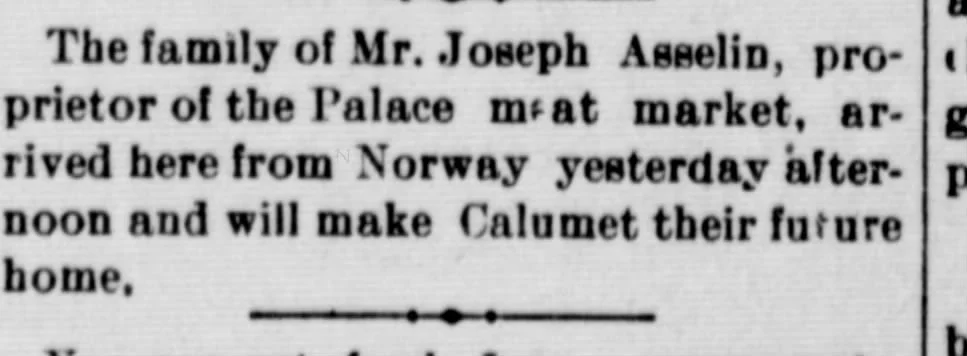
News item about the Asselins from The Calumet News issue from 6 August 1897, page 8, column 2.
Emile’s mother Cordelia died in 1909 of tuberculosis and is buried in the Asselin family plot in Lake View Cemetery in Calumet, Michigan. In 1911, Joseph married his third and final wife, Claudia. Joseph and Claudia had four children together: Leonard (1912, my grandfather), Francis (1913), Paul (1916), and Joseph (1919).
It’s unclear if Emile had been drawn to the military or pushed in that direction by his parents, but in 1912, at age 17, he reportedly returned to Calumet from a military academy in “De peer, Wis.” (more likely De Pere, WI). I find this location interesting because, as I was reminded recently in doing client research, Brown County, Wisconsin, where De Pere is as well as Green Bay, was one of the largest concentrations of French-Canadians in Wisconsin in large part due to the French fort that was built in that area long before it became American territory. But I have been unable to find a “military academy” that was open there during this time, so I’m continuing to research this piece of information.
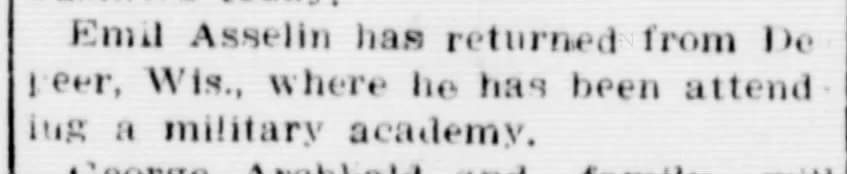
News of Emil returning to Calumet from The Calumet News issue from 20 November 1912, page 8, column 4.
At 21, Emile registered for the World War I draft, saying he had no past military service and worked as a chauffeur for Joseph Asselin of Calumet Michigan — his father owned a meat market, and multiple of his sons worked in this capacity over the years. Emile was reported as being of medium height and medium build with brown eyes and black hair.

Emile Asselin’s World War I draft registration card from Ancestry.
According to his personnel card, Emile enlisted on 1 September 1917, less than six months after the United States entered World War I, and his service went from Company B of the 54th Infantry to Company A of the 2nd Division Supply Trains and finally to Company B of the 2nd Military Police for less than a month before his death. It was with the 2nd Division Supply Trains that he was shipped overseas in January 1918. You can see Emile on this list of military police casualties, however, I’ll be honest that I’m not entirely sure what his function was in these various companies and I am not the most well-versed on military organization, so I don’t know for sure he was an MP.
It’s also worth noting that Emile’s older brother signed up to serve as well, with Don enlisting in July 1918 and honorably discharged in June 1919 — he would live until 1940 and die in the VA hospital in Dearborn, Michigan. I can’t imagine the stress that the family was under with two people serving, especially as just months after Don enlisted, Emile died.
Emile was wounded by shrapnel near Limey-Remenauville, France on 11 September 1918 and was moved to a hospital nearby where he died the next day. This photo album was created by the United States government to document the area in 1923, which is really interesting. But the town of Remenauville was destroyed over the years of the war, and Emile was just one of thousands of American soldiers and tens of thousands of total soldiers who died in this short period of time in this area of France. Emile was originally buried in Minorville, France, although his body was moved in 1919. A letter written by his cousin, Private Rudolph R. Asselin, to the Grave Registration Service, inquired as to the status of his deceased cousin on behalf of Joseph Asselin, and stated “St. Mihiel Front, Emile Asselin was first in Supply Truck Train Co. A. 2nd Div, the Military Police Co. A 2nd Div., wounded about Sept 11 or 21st. He was first in field hos no. 6 then transferred to field hos no’s 15 & 23. The place of his burial explained will be appreciated.”
Although the core of the St. Mihiel battle took place starting on 12 September, it seems Emile Asselin was among thousands of soldiers who were active in this area around the St. Mihiel salient from September 12-18, 1918. The video below shows some clips from this moment in France in 1918, which is very strange to see, because for all I know, one of the casualties being carried is Emile, but I have no photo of him to compare to.
The family was not notified until March 1919, which is supported by a few documents held at NARA, but the family must have been devastated by this news that not only did he die on “date unknown” but also they had no record of where he was buried.
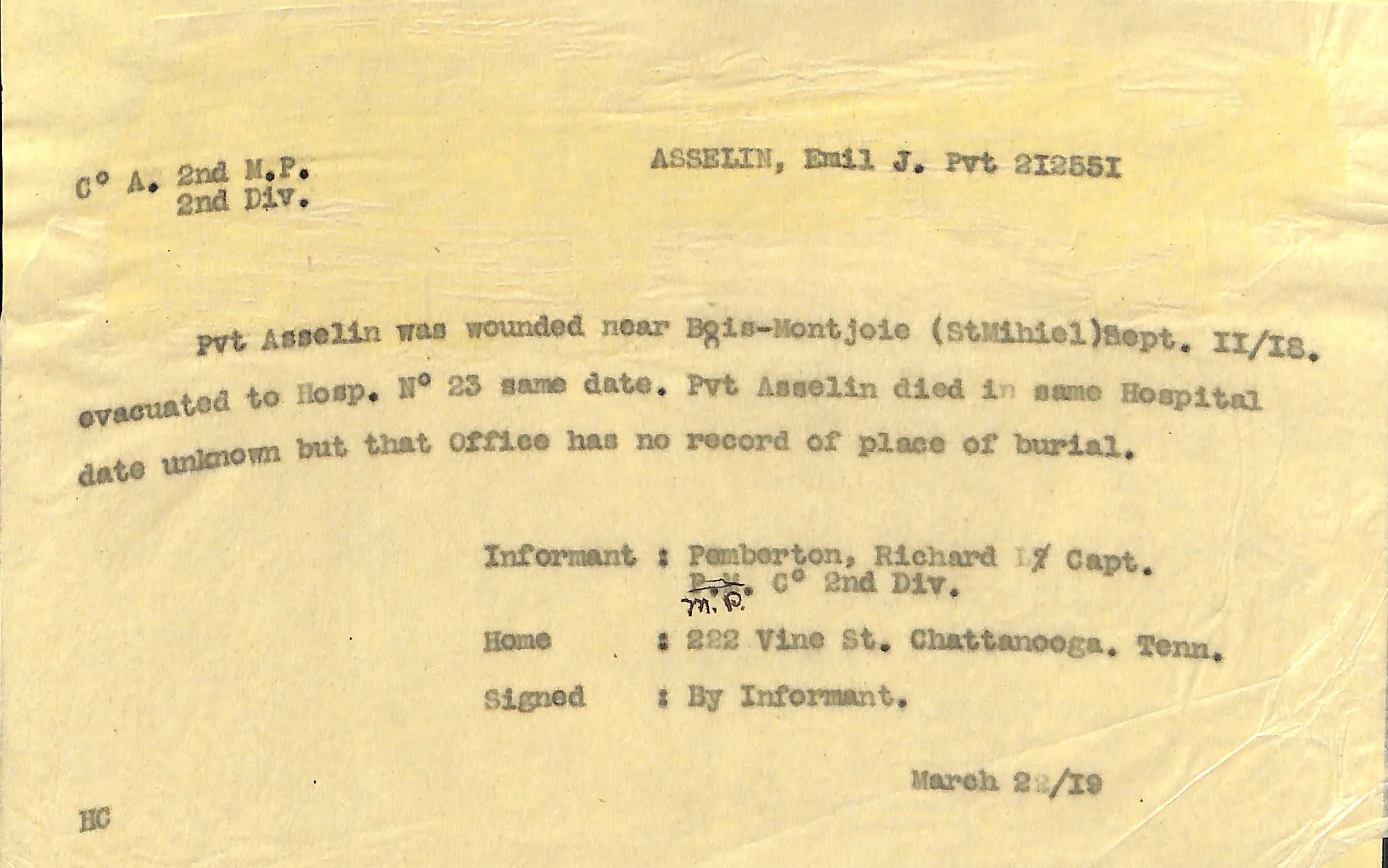
Note regarding the death of Emile Asselin from 22 March 1919, which I believe was the first the family was notified. From NARA.
It seems at first Joseph Asselin preferred his son’s body be returned to the United States, however eventually he told the government to keep Emile in the new St. Mihiel American Cemetery in Thiaucourt, France where he had been reburied in 1922 after the war. In the report from the Grave Registration Service it states a cross marked his original burial site and that an identification tag for Emile was attached to the cross. [I will not quote the report from when Emile’s body was exhumed for reburial because there are details about the condition of the body that I wish I didn’t have to think about, so be aware if you search for similar records related to your ancestors that this may be the case.]
A letter written by Emile’s eldest brother, Maxime, on behalf of their father Joseph Asselin to the Adjutant General of the Army in July 1920 on Joseph Asselin grocery letterhead, reads:
“Sir,
I wish to withdraw my request to have the body of my son returned to this country. The present place of burial of his remains according to information furnished me by the Graves Registration Service is as follows: Grave #64, section 5, lot 2, St. Mihiel American Cemetery #1233, Thiaucourt, M-Et-M.
His name, rank, etc. as follows:
Private Emile J. Asselin, 212551, 2nd Military Police, 2nd Division.
I much prefer that his remains lie at rest where he fought and died for our liberty and that they may also hallow the ground from which his ancestors spring.
Respectfully,
Joseph Asselin, father
by M.J. Asselin, brother.”
I find it particularly interesting that Joseph saw Emile being buried in France as returning to “the ground from which his ancestors spring” as that shows the perceived interconnection between French-Canadians in America and their French roots, despite the fact that the Asselins Joseph and Emile descended from had first left Normandy for Canada in the mid-1600s. Still, it’s a beautiful sentiment, and one that makes sense when you consider that both Joseph and Emile were 100% French-Canadian going back generations.
The United States government offered a widows and mothers program to take women overseas to visit the graves of military casualties after World War I (you can read more about this initiative here), and although Emile had no widow or mother who survived him, after some letters back and forth, his stepmother (my great grandmother), Claudia (Caron) Asselin went on this trip to honor him.
In 1933, Claudia set sail from New York on 17 May for France, sharing her travel arrangements with Clara Gauthier, the mother of Albert Gauthier who had also died in France. It’s unclear what the relationship between the two women was, but it seems Clara was Clara Drapeau prior to marriage and had grown up in the Keweenaw Peninsula in and around the same area Claudia had grown up in, with the two women both born in the 1870s, so they had likely become friends and wanted the comfort of familiar company on the trip.
The itinerary was busy, and Claudia was given the role of managing the group and making notes of their trip. On this day 93 years ago, her group arrived in France, and they spent their memorial day on May 29th at the cemetery visiting their soldiers. The trip included other cemetery and war site visits, but it also included trips to Versaille and the Louvre.
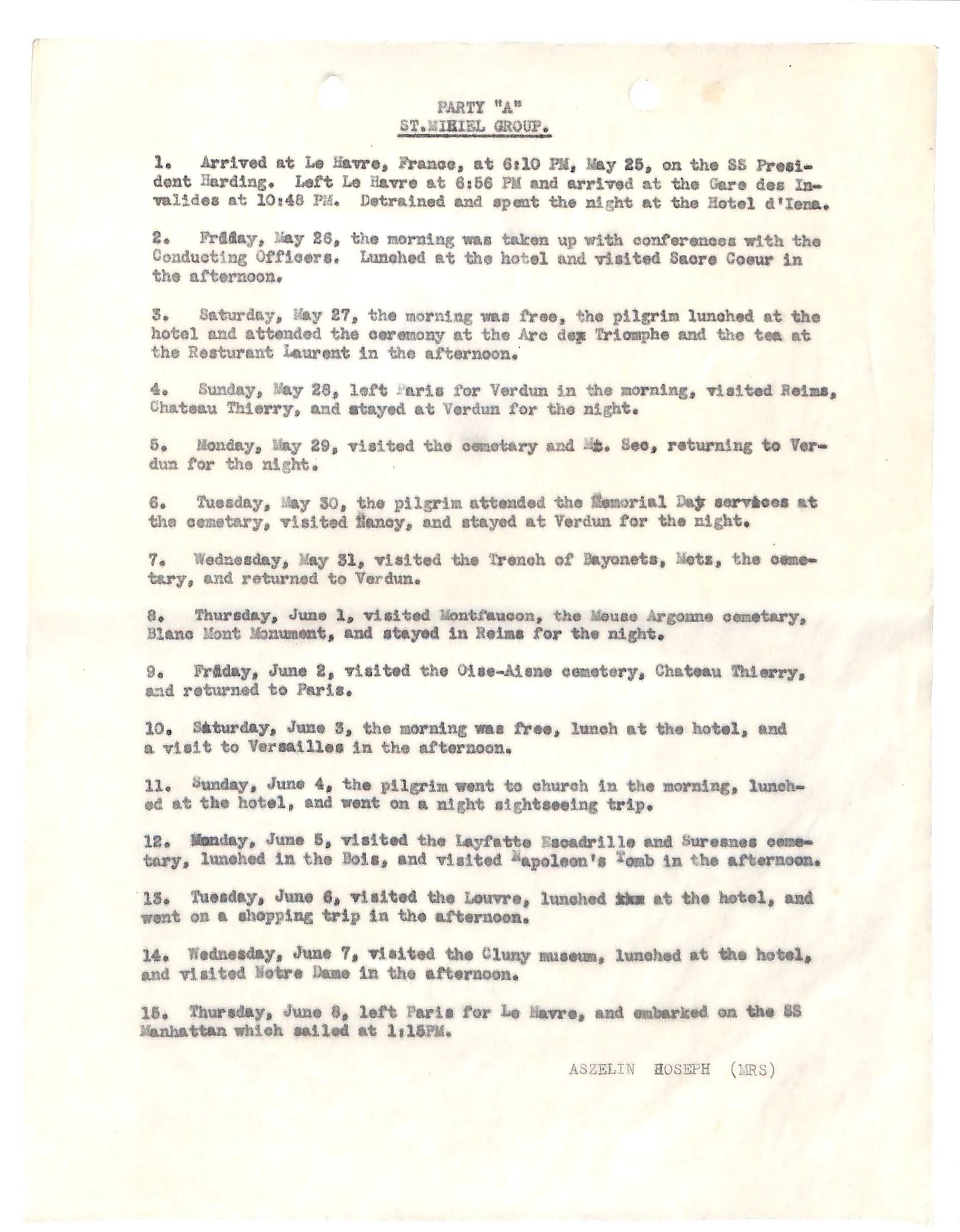
The itinerary notes for Claudia (Caron) Asselin’s Widows and Mothers Pilgrimage to France. From NARA.
This seems like an incredible trip and a large expense for the government to pay for multiple groups of widows and mothers to travel to Europe for nearly two weeks, but it’s also lovely that they did it. While I’m sure some accepted simply for the free trip, and it’s hard to know what relationship Claudia had with her stepson, it seems unlikely that a woman who had never left the United States before would do so only for the free trip, especially given that Joseph Asselin was quite well-to-do throughout his lifetime, so the family probably could’ve afforded trips to Europe if they were inclined to do so.
Once the group arrived back in the United States, Claudia sent a thank you note to the War Department for sending her and said she would “never forget it.”
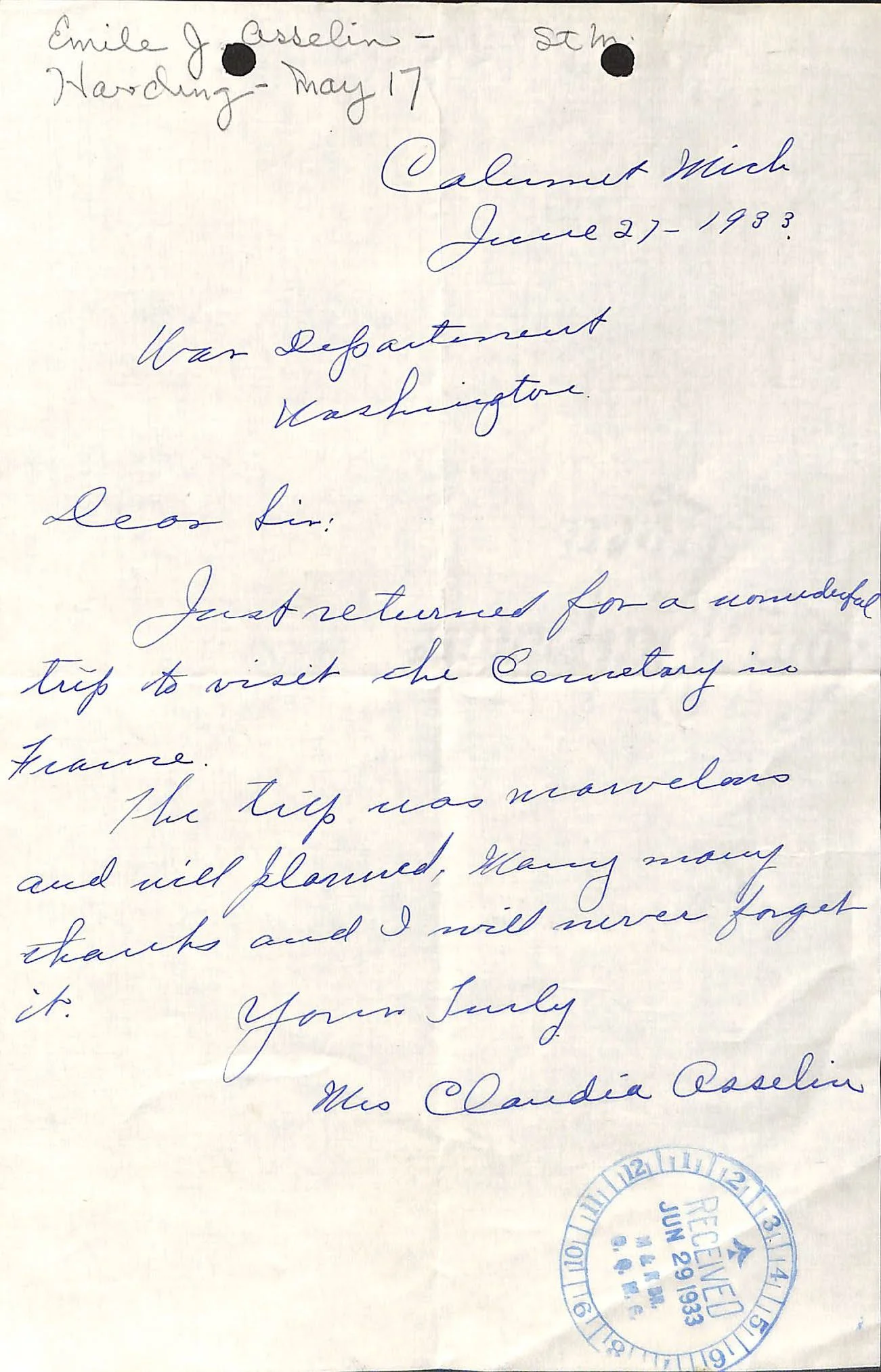
Thank you note from Mrs. Claudia Asselin to the War Department regarding her trip to visit the grave of her stepson Emile Asselin in France. From NARA.
The file held at NARA just for correspondence related to Emile’s burial and this trip for Claudia is nearly 100 pages and full of rich information that we genealogists love to see. When you can find a gold mine like this for your ancestors, it’s always a cause for celebration, even though I can’t say I needed to know that my great grandmother dealt with constipation while on her trip and I’m guessing she would not have loved it being preserved for all time in the National Archives either. But the richest part for me is seeing this note written in her own hand, which I had never seen anywhere else, as well as the letters from Joseph Asselin and his son/my great uncle Maxime Asselin.
Emile Joseph Asselin was only 23 years old when he died. He had lost his mother when he was 14 and was right in the middle of 10 siblings, one of which hadn’t even been born yet when he died. There are far more records regarding Emile’s death and burial than there are records about Emile’s short life.
My grandfather never really talked about his brother Emile when I was growing up, and of course by the time I learned about Emile’s sacrifice on the battlefields of France, my grandfather had also passed away. But I’m not sure how much my grandpa even knew about Emile, since he was only 5 when Emile enlisted and only 6 when he died.
This Memorial Day, I’m thinking of Emile, and all the other young soldiers, who might easily be forgotten over time. I hope to one day honor his memory by visiting St. Mihiel Cemetery, but for now, my hope is that as you read this, you consider the ways you might research relatives like Emile and keep the memory of their lives — however short they were — alive.