
52 Ancestors: What Wasn’t Written Down
This is part of the 52 Ancestors in 52 Weeks challenge that Amy Johnson Crow runs every year, although I’m shooting for more like 12 ancestors in 12 months.
Digging into my family history further back than we’ve gone before here on the blog, the theme of “what wasn’t written down” brought up a case I’ve been researching more deeply lately: the mysterious James Wilkie.
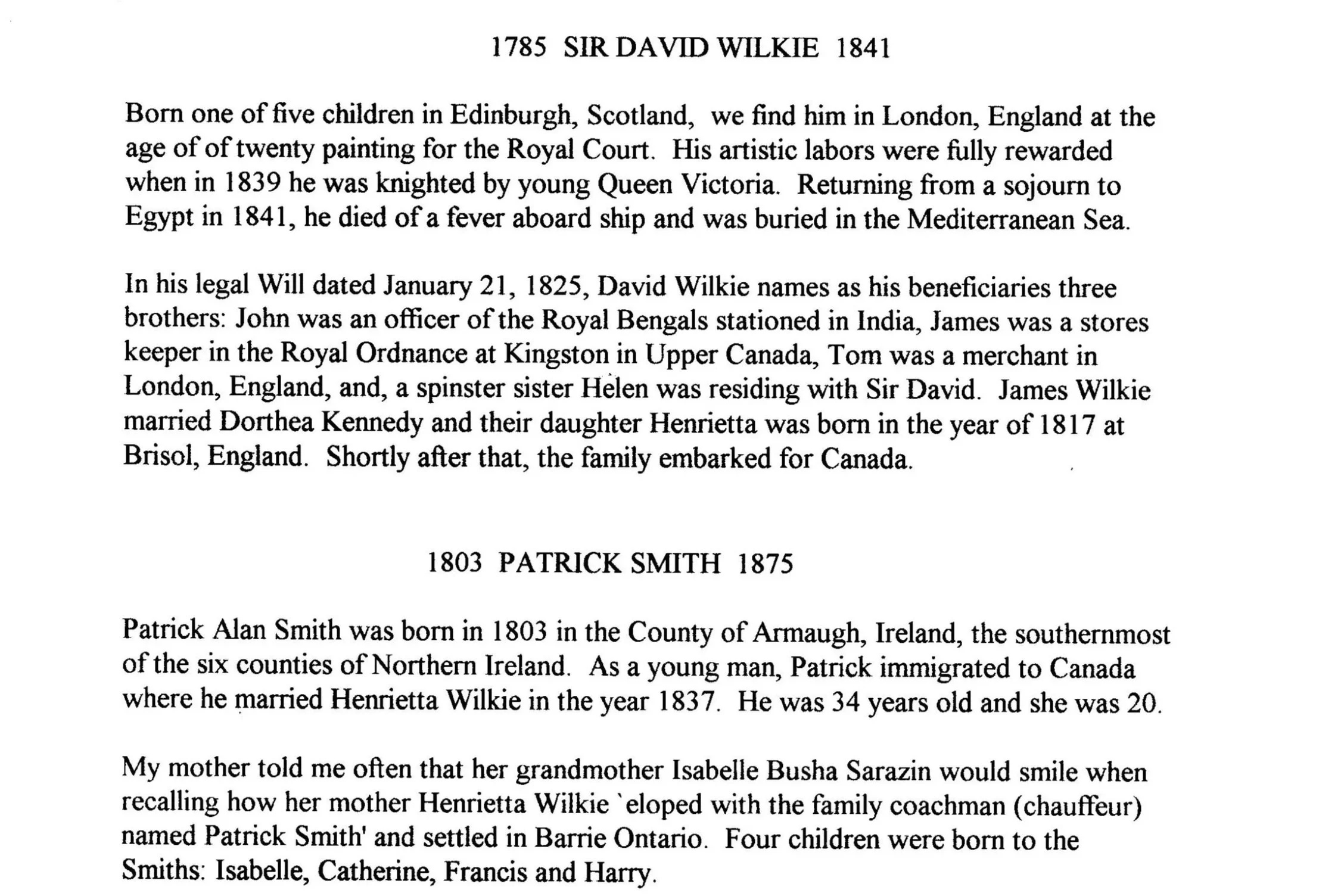
Document written by author’s great uncle Gordon O’Rourke. Contains some errors.
It’s long been family lore that we are related to the Scottish artist Sir David Wilkie, who was a royal portraitist in England and a contemporary (and friend) of J.M.W. Turner, who painted his burial scene. According to the document above, we are descended from David’s brother James Wilkie, who lived in Kingston, Ontario (then Upper Canada) via his daughter Henrietta Wilkie.
The first inaccuracy in this document is that James Wilkie’s wife was not “Dorthea Kennedy” but rather a woman named Dorothea Briscoe. Dorothea was the daughter of an Anglo-Irish landed gentry family who lived at Tinvane House near Carrick-on-Suir in County Tipperary. The origin of the “Kennedy” name listed for Dorothea is from the fact that after James’ death, Dorothea married a man named Myles Kenney from Ireland.
There were a few mysteries I wanted to solve regarding James Wilkie:
He was born in Scotland, so how and why did he end up in Canada?
Where did James Wilkie and Dorothea Briscoe meet and get married?
Where was their daughter Henrietta born — in Canada or in the UK?
If James worked in Canada, why was he buried in London?
The first question is sort of answered — James Wilkie did indeed work as the ordnance storekeeper for the British military in Kingston, Ontario. He held that role from 1815 until 1824. That is likely why he ended up in Canada, as they were anticipating his arrival for the job in 1815.
The second question is partially answered. Although I have not determined how they met, it seems likely her brothers who were in the military or her sisters whose husbands were in the military were a connection point for Dorothea and James. But according to the Kingston newspaper, they were married there by the Chaplain of the Forces in November 1818, not in Bristol, England in 1817.
The third question remains unanswered. The baptism of twin daughters Isabella and Helen who were younger than Henrietta occurred in Kingston in 1823, but as of yet, no record of Henrietta’s birth has been located.
The fourth question is where things get interesting.

A portrait of Captain James Wilkie painted by his brother Sir David Wilkie. Held at the National Galleries of Scotland.
James arrived in Canada in 1815, ready to report to work as the ordnance storekeeper in Kingston. This was an important position, particularly in the fraught years after the Revolutionary War and the War of 1812. The role was not officially a military one — James was not enlisted in the military — but instead was a civilian role that served the military.
A biography of Sir David Wilkie written in the late 19th century relayed that David had a difficult early 1825 because he lost first his mother and then his brother James returned to London after some financial troubles before dying and leaving David to support his widow and children. Of course, I wondered: what type of financial troubles did James encounter? And given that he had a decent job in Canada, what had occurred to send him and his family back to the UK?
I was lucky enough to discover a series of letters held at Library and Archives Canada that were written by, written to, or written about James Wilkie and his work as ordnance storekeeper in Kingston. These letters range from the mundane (inventory lists, updates on changes to storage, etc) to the… unusual.

Second page of a letter written by Military Secretary Addison regarding allegations of misconduct towards James Wilkie in 1817.
At first, it appeared that the allegations discussed in this letter were what had perhaps sent James Wilkie and family back to England, however this letter was written in 1817, eight years before his return. This is the first occurrence of “what wasn’t written down” in the case of James Wilkie, for despite the clear recommendation from Addison to make a case or leave him alone, there’s no overt statement of what exactly Wilkie was accused of, in this letter or any other. What appears to have occurred is that in the fall of 1817, Wilkie requested additional guards for the ordnance stores to provide better protection, and then perhaps that a military personnel accused him of misconduct regarding the stores and intended to arrest him. Addison reminded this person that Wilkie was not a member of the military, and he would need to meet certain criteria to be detained, and that the existing allegations did not fit that criteria.
After these letters, however, there were additional letters related to Wilkie’s work, and it was obvious he continued on in this role for some time. Realizing this was not the situation alluded to by his brother’s biographer, I kept digging. In late 1823, James Wilkie requested a horse, as he had been put in charge of multiple storehouses and needed it to travel between locations, so I knew he was still in the job then. Finally, in 1824 letters, I hit on allusions to what had occurred.
In April 1824, a letter stated that “from the Report of a Medical Board received from the general officers commanding in Upper Canada that Mr. Wilkie Ordnance Storekeeper at Kingston has been for some time wholly incapacitated from the performance of the duties of his office by the effects of paralysis.” The letter was recommending he be replaced by Richard Penn, esquire, formerly the Clerk of Survey in Quebec. The report mentioned in this letter was instigated by a letter from February 1824 signed by multiple officers that stated “we have lately observed a great change for the worse in his health (which affects his mind as well as his body).” What was this condition, and what did it have to do with his financial situation? If he was so ill, why did he return to England instead of staying in Canada? A newspaper article from the 1840s regarding the settlement of Sir David Wilkie’s estate explained that he had put down a large amount of money as a surety for James, and that the estate had settled the case. But the reasons why and the specifics of what happened?
That, unfortunately, was what was not written down.
From all of the details extracted from these letters so far (and I am not yet satisfied that all the relevant letters have been found, so digging continues), there are a few possibilities for what illness affected James Wilkie.
Stroke - given the description that he suffered from “paralysis,” this was the first place my mind went. But it doesn’t totally explain the other issues like his mental decline, nor the various other problems with his behavior and poverty.
Lead poisoning — this is an obvious possibility given that he was an ordnance storekeeper in a time when lead was used heavily in ordnance. He would have been exposed to a great deal of lead in his daily work. Chronic lead exposure could lead to lead encephalopathy which caused cognitive decline and motor weakness. To me, this is one of the top possibilities.
Alcoholism — alcohol use and abuse was very high in Canada at this time. Additionally, this could explain his friction with others from 1817 as well as his early death in 1825.
Neurosyphilis — this is a condition that develops if syphilis is left untreated too long, as it often was back in these days. It can cause stroke, neurological issues, mood disturbances, and personality changes. This matches most of the issues James had, but would raise the question of why Dorothea Briscoe wouldn’t have developed the same issues given that they had children together and she would have been exposed to it. Syphilis wasn’t very treatable until the development of penicillin, which would occur long after Dorothea was dead.
Since the letters written by these men working for the British government in Canada were often vague, not wanting to be more explicit in describing what had occurred or what the issues were, I may never know what ultimately led to James Wilkie’s decline. These things weren’t talked about overtly at the time, even if he were ill with something as basic as a stroke, and even more so if it were something like syphilis. Most likely, his illness was caused by lead exposure, but that still doesn’t fully explain why or how the financial troubles developed.
The Wilkies — James, Dorothea, Henrietta, Isabella, and Helen — left Canada in July 1824 and returned to England. James died 13 June 1825 and was buried in Camden, England. His parents were buried in Fife, Scotland; his brother David would be buried at sea in 1841; his wife Dorothea would return to Ireland with their three children, remarry Myles Kenney in 1829, return to Canada, and be buried in Barrie, Ontario; Isabella and Helen died as teenagers due to a dramatic mushroom poisoning incident that killed all of Dorothea’s children except Henrietta (who was married and out of the house) and Mary Kenney, who was not yet born, and they were buried in Barrie as well; and Henrietta lived only into her 30s and was buried in Barrie, while her children would go on to settle in the United States. James Wilkie alone is buried in England, and no one wrote down exactly what killed him or why a life that seemed promising at his marriage in 1818 ended up so full of struggle.
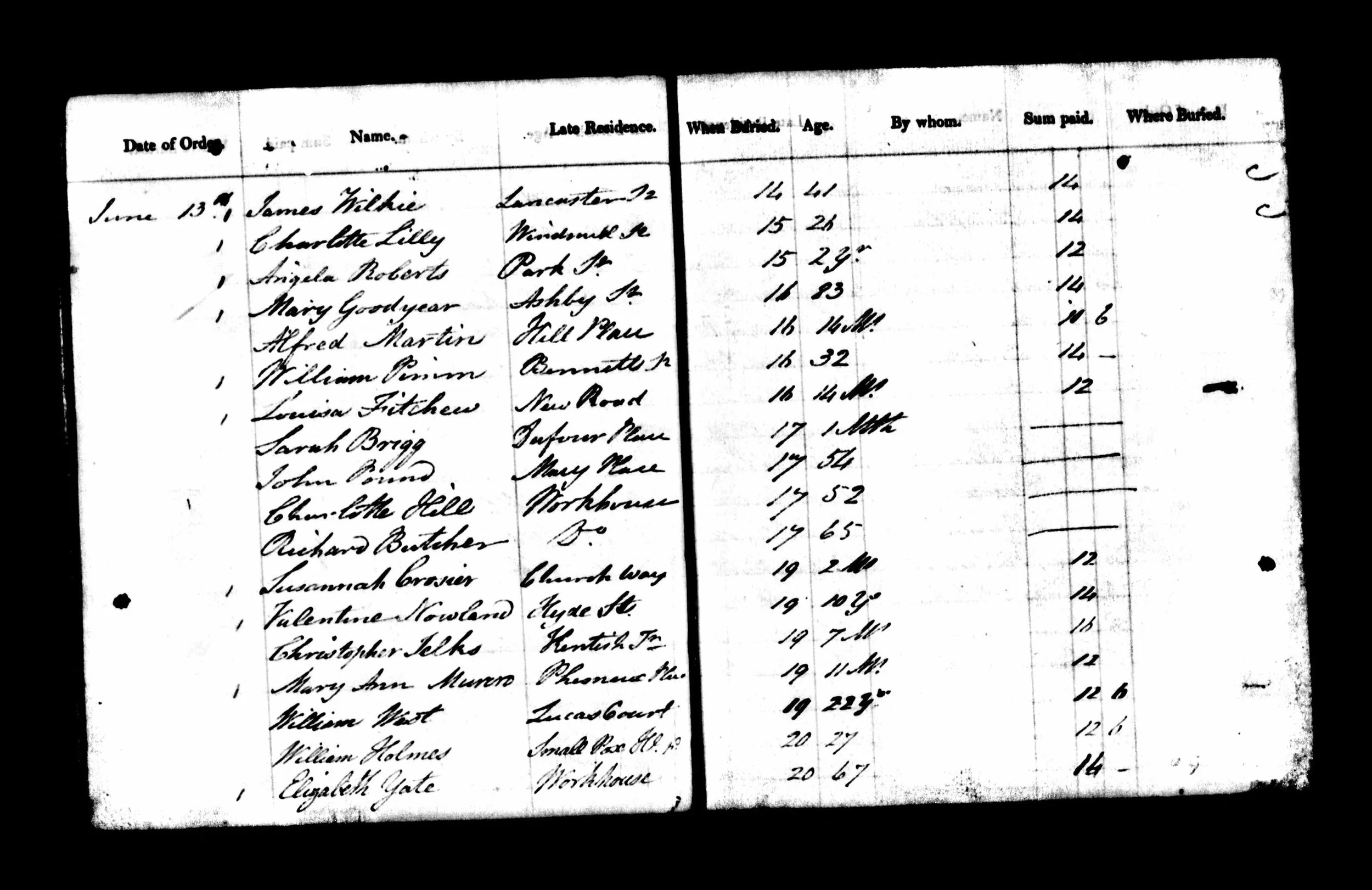
Burial register for Camden, England. James Wilkie appears on the first line.