How Probate Records Reveal Your Ancestor's Story
Many intermediate and experienced genealogists rely on probate records, but for beginners, these court files can feel daunting. Created to settle a deceased person’s estate or establish guardianships, probate records are often surrounded by a common myth: that they only exist for the wealthy or that they are particularly complex to utilize. In reality, they span across socio-economic classes, eras, and regions, and they can be incredibly useful for genealogical research. If you’re ready to level up your research, understanding probate is the key to unlocking your family’s true story.
Why Probate Records Aren't Just for the Wealthy
Depending on the location, many jurisdictions required probate to settle any estate, and in the United States, defining that process began with the first permanent settlements and grew from there. It has historically not mattered if a person was poor or wealthy, but instead, if that person owned property or had guardianship over minor children.
Say one of your ancestors had purchased land through the United States government in a Midwestern state, and they settled there with their spouse and children, but life was hard and they were struggling to get by. Then the property owner died, leaving a spouse and either adult or minor children. The estate itself may not be of much value, but court proceedings are required to determine what happens to it.
Most important in this regard is the fact that probate records aren’t only for estates where there was a will — in fact, in many cases, probate was more important when there wasn’t a will in place for the deceased. Keep this in mind as you consider what relatives might have left behind probate files.
Decoding the Terminology: Testate, Intestate, and Beyond
One of the most daunting parts of navigating probate records is the terminology. Here’s a glossary that should help with that:
Testate — someone who dies “testate” is someone who had a valid will when they died. Typically, you’ll find their will along with the other probate records in the file. Dying “testate” historically is definitely more common among men, particularly men with a good amount of property or money, but especially in the 20th century and beyond, could include anyone.
Intestate — someone who died “intestate” didn’t have a valid will. This requires the probate court to track the intestate settlement process for the deceased’s property.
Executor — this is the person who manages the execution of a testate probate process. They are executing the wishes of the will. Particularly in non-modern records, you may also see “executrix” which is the term used for a woman who is performing this role.
Administrator — for an intestate probate case, an administrator is appointed to oversee the settlement of the estate. Similar to executor/executrix, in the past the term “administratrix” was used for women in this role.
Heirs — these are the people set to inherit from the estate, either as defined by the will or by law for intestate cases.
Probate Court, Orphans’ Court, Surrogates’ Court, Register of Wills — these are all different names that have been used to describe the same type of court. Typically, courts that handle probate are at the county level, but historically, they’ve also been managed at local or state levels.
What You Can Discover Inside a Probate File
Depending on the location you are researching, probate files are likely to include a grouping of documents that have been digitized or filed together as being part of one court file. These files typically include documents such as:
A will (or more than one, if there’s a dispute over which will is valid)
Application for Letters of Administration or a petition to start probate proceedings
Letters of Administration (identifies the administrator)
Inventories of estate property (land, goods, money, etc.)
Accounts and receipts for debts paid during the probate process such as a bill from a general store and documentation the bill was paid
Appointment of Guardian for minor children
Bonds for the executor or administrator
Proofs of Heirship (if there is some need to establish proof of who the heirs are)
Proof of Publication (often newspaper ads were run for a specific amount of time to inquire if the public had issues or debts involved in the estate)
But if you’re here, you’re likely wondering what information you will find in a probate file, not just what types of documents. The good news is that you are likely to find information about the deceased’s heirs, their property, and their economic situation. Particularly with heirs, a will might define the relationships of the people, and in intestate cases, the heirs will be described by relationship to the deceased.
Examples of Genealogical Probate Findings
If you are curious, here are some of the gems I’ve located in probate files for my family history research.
Thomas LeBlanc Probate File
I’ve written about my 3x great grandfather Thomas LeBlanc before, including here. One of the items in his probate file that I found most interesting was this receipt signed by my 2x great grandmother, his daughter Anna LeBlanc Drouillard, who was a minor when he died.
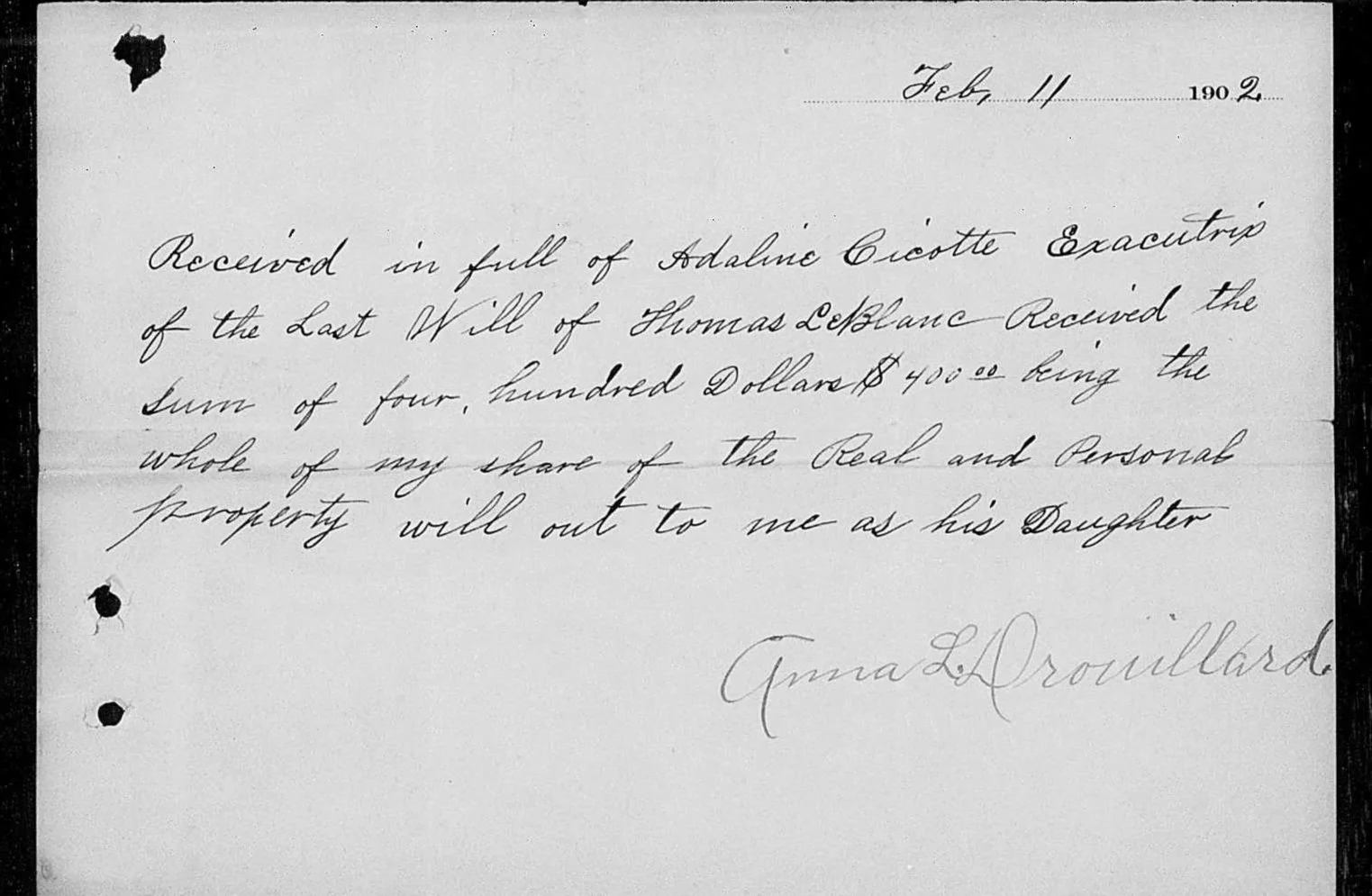
Thomas LeBlanc Probate File, Wayne County Probate Court, Michigan.
One interesting thing to note is that this receipt is from 1902, and Thomas died in 1887. Anna was quite young when her father died, so it was quite a while before she got her inheritance.
Thomas’s estate file included his multi-page will, a full listing of all his living children (at his time of death) from multiple marriages including current town of residence for the adult children, a description of his real estate, details related to his widow and administratrix Adeline McQuillen LeBlanc including that she later remarried and surname became Cicotte, an appraisal of his real and personal estate including that he held mortgages for three people, and an inventory of his belongings and their value, such as “one large double wagon” and “224 cords of top wood.”
Toussaint Drouillard Probate File
Toussaint Drouillard was my 4x great grandfather (and I’ve written about his property specifically before as well), and he was quite similar in residence and economic situation to Thomas LeBlanc (and was Thomas’s brother-in-law, as Toussaint’s wife Therese was born Therese LeBlanc and was Thomas’s sister). Like Thomas, Toussaint left a will, so he died testate. One of the best finds in Toussaint’s probate file is this map breaking down the division of his real estate among his heirs:
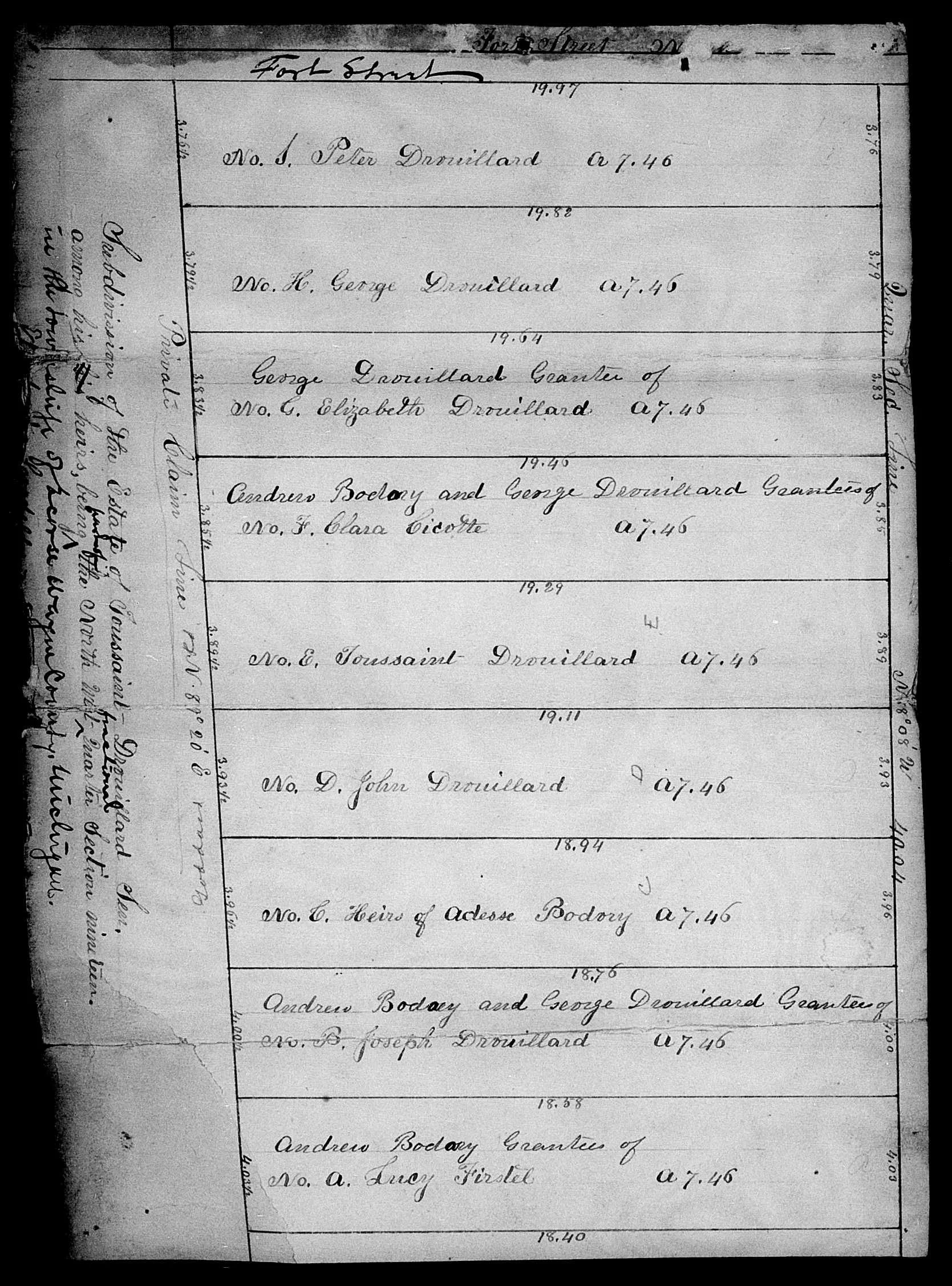
Toussaint Drouillard Probate File, Wayne County Probate Court, map of real estate in Ecorse, Michigan.
Like Thomas’s probate file, Toussaint’s included a list of all of his heirs, including some grandchildren who inherited due to their mother predeceasing her father. It also includes a written statement from George explaining Toussaint had wanted his estate to fully go to his wife Therese during her lifetime and only after she died should it be divided up and given to his heirs, and she had died in March 1879 so now they were ready to finish Toussaint’s probate. This document also explains that George had gotten some of the shares of other heirs’ inheritances and named the heirs of Toussaint’s deceased daughter Ades Drouillard Bodary who now inherited from their grandfather. The file also includes multiple written descriptions of Toussaint’s real estate, inventories of his property (including “400 lbs pork” and “28 bushel potatoes” as well as “2 thousand white wood shingle” and “2 mares.”
Ida Ferrier Mead Probate File
In a more recent example, my 2x great grandmother Ida Ferrier Mead died on 13 March 1935, and her daughter Lefa Mead Amsden was named her executrix via Ida’s will. The records for Ida are from Ohio and likely because they are copies, are typewritten vs. handwritten compared to the two examples above.
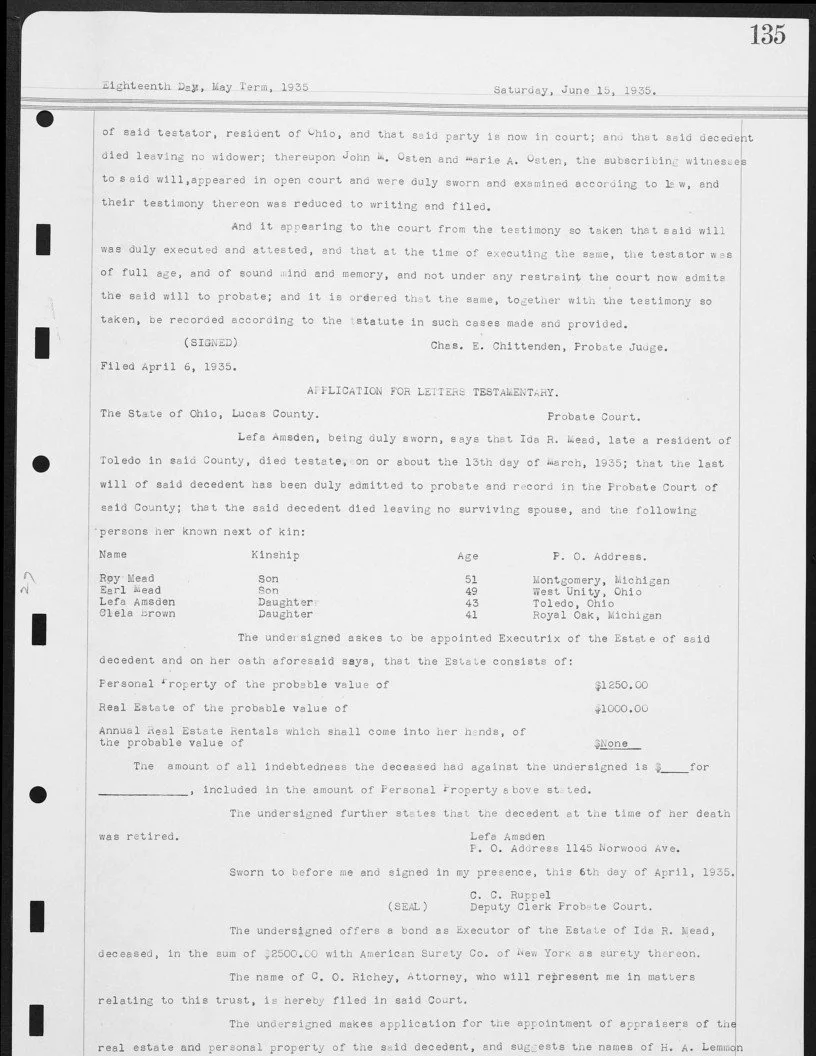
Ida R. Mead Probate File, Lucas County, Ohio Probate Court.
In the document above, you can see how it names her next of kin as Roy Mead, Earl Mead, Lefa (Mead) Amsden, and my great grandmother Clela (Mead) Brown. One particularly interesting thing about Ida’s probate file is that despite these being her named next of kin, in Ida’s will, she leaves inheritances to all of her children other than her son Roy. The three others were to split equally four different lots in Hudson, Indiana. It’s unclear as of yet why she might have left Roy out of her will, but he was living when Ida died, so it was definitely a purposeful omission.
Something else worth noting with Ida’s probate file is that although the proceedings took place in Lucas County, Ohio, where Ida had spent her final years after the death of her husband living with her daughter Lefa, because the case required a transfer of real estate in Steuben County, Indiana, the file I located was a copy held there instead. It’s good to keep in mind to look for probate records both where an individual died and where they owned property, if you are trying to locate a file.
How to Locate and Access Probate Records
One of the more daunting aspects of probate files is how to locate them, even if you might know where an individual lived or owned property. Even within the United States, the specifics of probate law and how the courts operate can vary, particularly depending on the era, so the most important aspect of probate research is actually understanding the jurisdiction you are researching in.
A good place to start when looking for any type of record is the FamilySearch Wiki. You may also have luck searching online for a location + “probate court” to learn what currently exists. Keep in mind you will be probably searching at a county level, and if “probate” doesn’t have relevant results, utilize some of the other names for these courts that were mentioned above. Probate files, while incredibly useful for genealogical research, seem to be slightly less digitized than many other types of records, so you might need to go in person to do some research.
In Wisconsin, you can access historical probate records for any county up to around the 1950s through the Wisconsin Historical Society’s archives, although note that if you are hoping to access a particular record, you should request it ahead of time, particularly if it needs to travel by inter-archive transfer. Wisconsin is not unusual in having its state archive hold older probate files — for instance, the Archives of Michigan is also the repository for older Michigan probate court records. So keep in mind, even if you identify the likely court where your ancestor might have a probate file, that court may not hold those records any longer, and instead you might need to reach out to a separate archive.
Finally, if you are researching older probate files, you are likely to only face restrictions on access if you are trying to see probate related to guardianship, which typically have more privacy protections in place. So adoption records held by probate courts, or mental health guardianship records, and similar other records are not likely to have the same access rules as general estate probate files. Depending on the jurisdiction, you might need a court order to access these other types of probate files, if you are able to gain access at all. However, for estate files, many states have rules where once a certain amount of time has passed, they are accessible to the public.
It might take some effort to locate where the relevant files would be held, but you are likely to uncover a wealth of information once you find them.
Uncovering probate files can sometimes feel like reading a 19th-century family drama! Have you hit a brick wall trying to locate or decipher a probate file for your ancestor? Explore my Research Services or send a message to see how I can help trace your family's legal trail.