The Uncanny Valley: Why I’m Wary of AI Photo "Restoration"
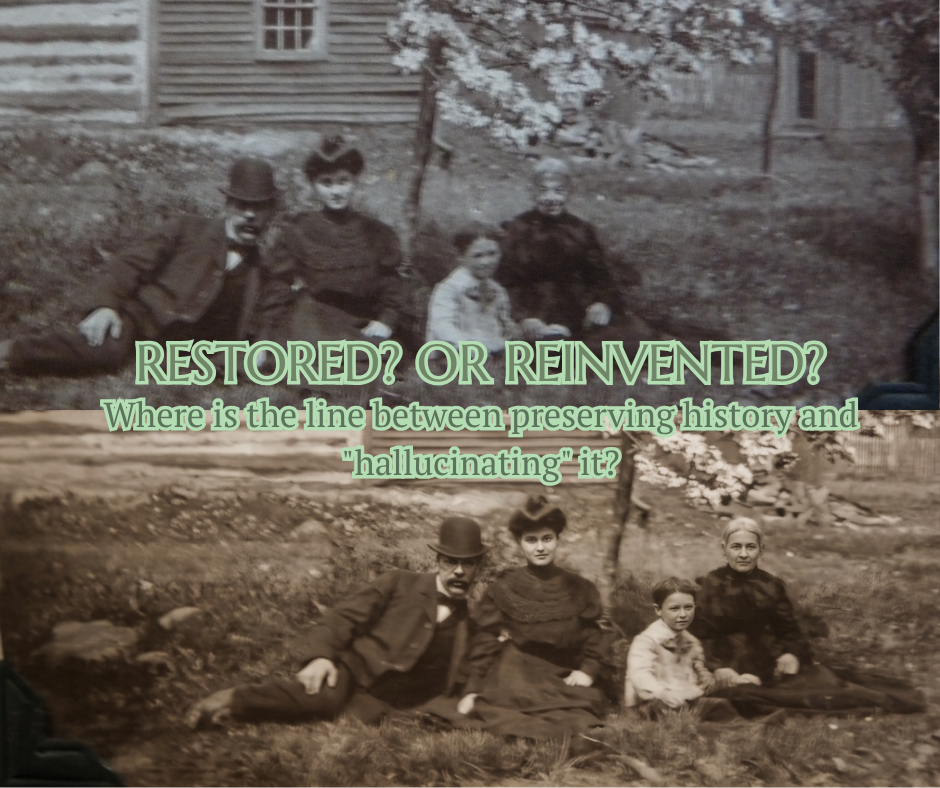
A family photo that includes my 2x great grandmother Margaret Morin (far right) in both original and an AI “restoration” format.
I have a complicated relationship with Artificial Intelligence. Most people who know me have heard at least one rant about the dangers of using it indiscriminately. My cynicism isn't without cause; I worry about the staggering environmental impact of massive data centers and the "cognitive offloading" that happens when we stop doing the hard work ourselves—much like the documented cases of professionals whose skills atrophied after relying too heavily on automated tools.
And yet, I’m not a Luddite. I use Alexa in my home, and I’ve collaborated with AI like Gemini to help streamline locality guides or draft complex citations.
But there is one area where my skepticism hits a hard wall: the use of AI to "restore" our ancestors.
The Allure and the Trap
I recently read a PetaPixel article regarding the rise of AI-driven photo restoration that stopped me in my tracks. As a photographer who shoots both digital and film, I have a deep reverence for the "moment in time" a photograph captures.
We’ve all seen the trend: a grainy, 19th-century tintype is fed into software, and seconds later, it spits out a hyper-realistic, smoothed-over face. It’s compelling. There is something undeniably powerful about seeing a long-dead relative with clarity that feels more intimate and real than any paper record could ever be.
But at what cost?
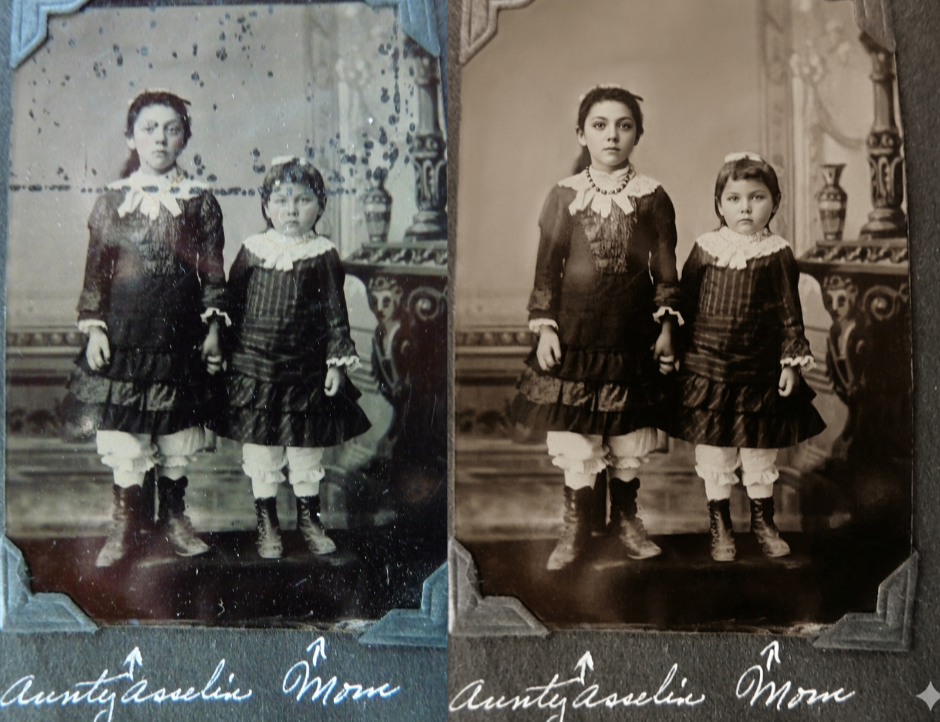
My great grandmother Claudia Caron (right) and her sister Anna (left) in both the original, distressed version and in an AI “restoration” of the photo.
When Does an Image Lose Its Meaning?
I’m no stranger to the digital (or physical) darkroom. I crop, I adjust contrast, and I shift exposure to bring out hidden details in my digital work. But there is a massive leap between enhancing what is there and inventing what is missing.
In our current era of filters and influencers, we’ve already reached a point where we can’t fully trust the images we see. But for a genealogist, a photo is meant to be a factual record. When AI "fills in the blanks" of a weathered face, it isn't uncovering the truth—it’s making a highly educated guess based on millions of other faces. It’s a digital hallucination.
If we manipulate these old photos so far beyond their original appearance, are we still looking at our ancestors, or are we looking at a computer’s interpretation of them?
A Question for Future Generations
The adage says "a picture is worth a thousand words," but as genealogists, we know those words must be true to be valuable. If we pass down hyper-processed, "perfected" images to the next generation, we risk losing the authentic connection to the past.
At what point does the image lose all historical meaning? If we erase the grain, the wear, and the actual light captured a century ago, we might be creating a beautiful picture—but we might also be erasing a piece of history. Part of what I really love about shooting on film is the feel, the grain, the limits of knowing you only have so many shots per roll, and the end result of a physical photograph. We have already shifted our modern family photos to a digital realm as most people rely solely on photographs taken with cell phones that are only held digitally. Future generations may not even be able to access our photos as technology evolves, so without a physical object to pass down, those images may be lost forever. (Print your favorite photos, folks!)
On top of all of that, will future generations have to figure out if images are real or not?
Ultimately, I’d ask anyone using these “restoration” tools to think about what they are really gaining. It’s not a true look at your ancestors, so what’s the point? Would you want your descendants to see an artificial image of you that didn’t reflect who you really were? There may be valid uses of AI, including in genealogy, but this doesn’t align with our focus on true history.
Where do you draw the line? Is a sharpened AI image better than a blurry or grainy original, or is the blur part of the story?